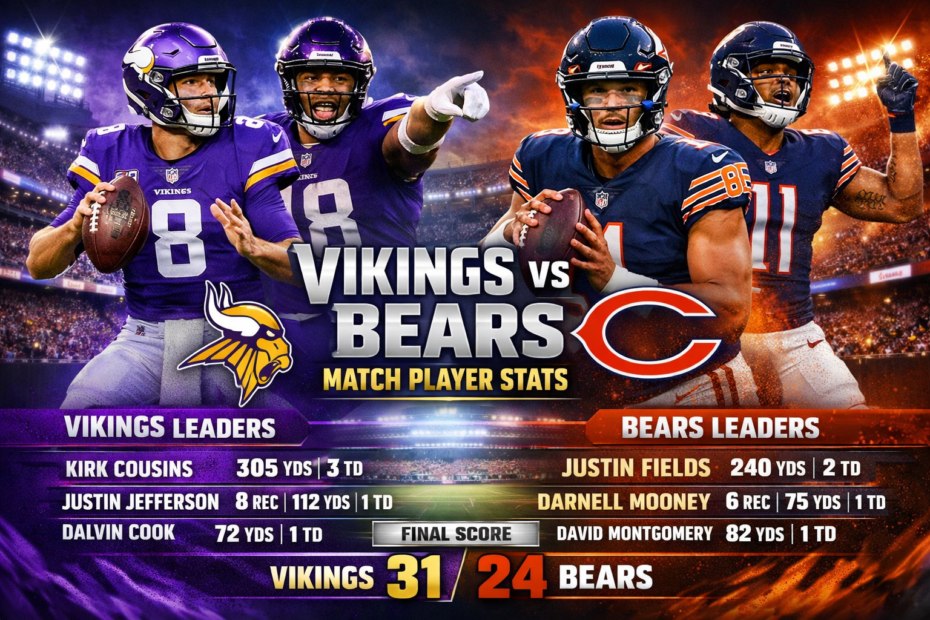
The Ultimate Guide to Minnesota Vikings vs Chicago Bears Match Player Stats
When you look for the Minnesota Vikings vs Chicago Bears match player stats, you are diving into one of the most exciting rivalries in professional football. This NFC North battle always brings high energy and incredible individual performances that keep fans on the edge of their seats. Whether it is a chilly afternoon at Soldier Field or a loud game inside U.S. Bank Stadium, these two teams play with a special kind of fire. Understanding the numbers behind the hits and touchdowns helps every true fan appreciate the game on a much deeper level.
Watching these athletes compete is truly a masterpiece of modern sports. Every yard gained and every pass completed tells a story of hard work and elite skill. The data from these games reflects the gritty nature of the Midwest, where defense is king and every possession matters. In our detailed look at the numbers, you will find everything from quarterback ratings to defensive stops. We focus on giving you a clear picture of who dominated the field and how their efforts changed the final score for their legendary teams.
The history between these two franchises is filled with legendary names and record-breaking moments. From the early days of the league to the modern era of high-flying offenses, the stats provide a roadmap of how the game has evolved. Fans love to compare current stars to the legends of the past to see who truly owns the division. By looking at the latest data, we can see which players are rising to the occasion. This guide is your perfect companion for understanding the incredible impact these players have on the gridiron every single season.
Quarterback Performance: Leading the Charge
The quarterback position is the heartbeat of any team, especially in this intense divisional rivalry. When we examine the Minnesota Vikings vs Chicago Bears match player stats, the focus usually starts with the men under center. In recent matchups, we have seen a fascinating mix of veteran leadership and young talent trying to make a mark. Their ability to read the defense and deliver accurate passes determines the rhythm of the entire game. A strong performance here often leads to a victory, while mistakes can be very costly.
Looking at the passing yards and completion percentages gives us a glimpse into the tactical battle between coaches. The Vikings often rely on a precise passing attack that looks to exploit gaps in the secondary. On the other side, the Bears have frequently utilized mobile quarterbacks who can extend plays with their legs. This contrast in styles makes the statistical comparison very interesting for analysts. Seeing how many touchdowns were thrown compared to interceptions provides a quick health check on the offensive efficiency for both squads during their meetings.
Beyond just the basic numbers, the “clutch factor” is often reflected in third-down conversion rates. Great quarterbacks find a way to move the chains when the pressure is highest. By studying the sacks allowed and the passer rating under duress, we see the true grit of these leaders. The data proves that the team with the more composed quarterback usually controls the clock and the scoreboard. It is this high-stakes environment that turns regular players into heroes in the eyes of the screaming fans in the stands.
Ground Game Dominance: Rushing Yards and Power
Football in the NFC North is often won in the trenches, and the rushing stats prove it. The Minnesota Vikings vs Chicago Bears match player stats show a long history of powerful running backs who thrive in tough conditions. A strong ground game does more than just score points; it wears down the opposing defense and keeps the clock moving. Watching a star runner find a tiny hole in the line and burst through for a huge gain is one of the most beautiful sights in the sport.
The statistics for carries and yards per attempt tell us how well the offensive line is performing. If a team is averaging over four yards per carry, they are usually in a great position to win the game. We also look closely at “yards after contact,” which highlights the individual strength and determination of the runners. The Bears have a tradition of legendary “monsters of the midway” who punish defenders, while the Vikings have often showcased explosive backs with elite breakaway speed and great vision.
Touchdowns on the ground are the ultimate reward for a long, physical drive. When the game reaches the “red zone,” the rushing stats become even more critical. Coaches look for players who can punch the ball into the end zone from just a few yards out. By analyzing the number of first downs earned via the run, we can see which team was more physical. This part of the game is about heart and will, and the numbers are a direct reflection of that tireless competitive spirit.
Receiving Excellence: The Playmakers Outside
Modern football is built on the shoulders of elite wide receivers and tight ends who can catch anything. In the Minnesota Vikings vs Chicago Bears match player stats, the receiving numbers are often the most eye-popping part of the box score. Whether it is a deep post route or a quick slant, these playmakers turn small gains into massive touchdowns. Their ability to create separation from defenders is a skill that takes years of practice and incredible athletic ability to master.
Target share is a vital stat because it shows which players the quarterback trusts the most. When a receiver gets double-digit targets, you know they are the focal point of the offensive strategy. We also track “yards after catch” (YAC), which measures what happens after the ball is caught. This stat separates the good receivers from the truly great ones who can make defenders miss in the open field. Both teams have featured All-Pro talents who can change the game with just one spectacular catch.
Don’t forget the tight ends, who act as the ultimate safety net for the offense. Their stats often include critical catches on third down and big blocks in the run game. Looking at the reception totals for these versatile players shows how much they help balance the attack. The battle between a star receiver and a shut-down cornerback is a game within the game. The statistics from these individual matchups are what fans talk about at the water cooler the next morning after a big game.
Defensive Masterclass: Tackles, Sacks, and Picks
While the offense gets the glory, the defense wins championships in the black-and-blue division. The Minnesota Vikings vs Chicago Bears match player stats for the defensive side are filled with big hits and game-changing turnovers. Total tackles show us who was most active on the field, flying from sideline to sideline to stop the ball. A high number of tackles for loss (TFL) indicates a defensive line that is living in the opponent’s backfield and causing total chaos.
Sacks are perhaps the most exciting defensive stat because they can completely stall an offensive drive. Seeing a defensive end beat his blocker and take down the quarterback is a massive momentum booster for the team. We also keep a close eye on “quarterback hurries,” which don’t always show up in the main box score but are just as important. Forcing the passer to throw early often leads to mistakes and poor decisions. This pressure is the foundation of a winning defensive game plan.
Turnovers are the statistics that most often decide the outcome of the match. Interceptions and forced fumbles are pure gold for a defense. When a safety reads a quarterback’s eyes and snags the ball out of the air, the stadium erupts in a frenzy of joy. These plays shift the energy of the game instantly. By looking at the turnover margin in the player stats, we can almost always predict who walked away with the win. It is a testament to the skill and timing of these elite athletes.
Special Teams: The Hidden Impact
We cannot talk about the Minnesota Vikings vs Chicago Bears match player stats without mentioning the specialists. Kickers and punters often fly under the radar until the game is on the line in the final seconds. Field goal percentage is a crucial stat, especially when games are decided by three points or less. A kicker who can consistently hit from over 50 yards is a massive weapon that changes how a coach calls the game. These players have nerves of steel and perfect technique.
Punting stats like “yards per punt” and “punts downed inside the 20” are all about field position. Forcing the opponent to start their drive 90 yards away from the end zone makes life much easier for the defense. A great punter can flip the field and put the other team in a very difficult spot. We also look at the return yards from the kick and punt returners. One big return can set the offense up with a short field and lead to an easy score for the team.
Special teams are often called the “third phase” of the game for a good reason. The stats in this category show the depth and discipline of a roster. Players who excel here are often fighting for their spot on the team, and they play with incredible intensity. Whether it is a blocked punt or a perfectly placed kickoff, these moments are vital. The numbers tell us that special teams can be the difference between a winning season and a disappointing one for these two rivals.
Detailed Player Stats Table: Recent Matchup
| Player Name | Team | Position | Key Statistic | Total Value |
| Caleb Williams | Bears | QB | Passing Yards | 193 |
| D’Andre Swift | Bears | RB | Rushing Yards | 90 |
| Cairo Santos | Bears | K | Field Goals Made | 4 |
| J.J. McCarthy | Vikings | QB | Passing Yards | 150 |
| Justin Jefferson | Vikings | WR | Receiving Yards | 44 |
| Jordan Mason | Vikings | RB | Rushing Touchdowns | 1 |
| Kevin Byard | Bears | S | Interceptions | 1 |
| Nahshon Wright | Bears | CB | Interceptions | 1 |
| Will Reichard | Vikings | K | Field Goals Made | 1 |
Historical Context: A Century of Competition
The rivalry between Minnesota and Chicago is not just a game; it is a tradition that spans generations. Looking at the Minnesota Vikings vs Chicago Bears match player stats over several decades reveals how much the sport has transformed. In the old days, the numbers were dominated by legendary middle linebackers and bruising fullbacks. Today, the stats reflect a much faster, more specialized game. This historical perspective allows fans to see the evolution of strategy and athleticism in the NFC North division.
Comparing the all-time leaders in passing yards or sacks between these two teams is a favorite pastime for sports historians. Some records have stood for forty years, while others are being challenged by the young stars of today. These numbers serve as a bridge between the past and the present, connecting fans to the legends their parents and grandparents cheered for. Every time a new player enters the record books, they become part of a storied legacy that defines the culture of both cities.
The stats also highlight the periods of dominance for each franchise. There were years when the “Purple People Eaters” of Minnesota were unstoppable, and other times when the Bears’ defense was the best in the world. Seeing these cycles in the data helps us understand the competitive nature of the NFL. No matter who is on top, you can be sure that the next matchup will be a battle for the ages. The statistics are the permanent record of that endless struggle for divisional glory.
The Fan Experience: Why Stats Matter
For the average fan, the Minnesota Vikings vs Chicago Bears match player stats are more than just numbers on a screen. They are the fuel for fantasy football leagues and friendly debates at the local sports bar. Stats allow fans to feel like they are part of the team by understanding the technical aspects of the game. When your favorite player has a career-high game, those numbers become a source of pride and excitement for the entire community of supporters.
Digital technology has made it easier than ever to track every single play in real-time. Fans can now look at advanced metrics like “expected points added” or “completion probability” while the game is still happening. This wealth of information has created a more informed and engaged fan base than ever before. People don’t just want to know who won; they want to know how they won and who played the best. The data provides those answers in a clear and satisfying way for everyone.
Ultimately, the stats are a celebration of the athletes’ incredible dedication to their craft. We see the result of thousands of hours of training in a single number on a chart. It is inspiring to see how these players push themselves to the limit for their teammates and their fans. As we look forward to the next game, the stats from the past give us clues about what might happen next. It is this anticipation and analysis that makes being a football fan such a rewarding and joyful experience.
Keys to Future Success: What the Data Tells Us
By analyzing the Minnesota Vikings vs Chicago Bears match player stats, we can spot trends that might predict future success. One key trend is the importance of protecting the football. Teams that win the turnover battle have a massive advantage in the win-loss column. Coaches use this data to adjust their practice routines and game plans. If the stats show a weakness in pass protection, you can bet the team will spend extra time working on their blocking schemes during the week.
Another important factor is “explosive play” rate. The numbers show that teams that can generate plays of 20 yards or more are much more likely to score. Finding ways to get the ball into the hands of fast playmakers is a top priority for offensive coordinators. On the flip side, the defense must limit these big plays to keep the score low. The stats act as a diagnostic tool, pointing out exactly what is working and what needs to be fixed before the next kickoff.
Finally, the health and longevity of the players are reflected in the “games played” and “snap count” statistics. Keeping your best players on the field is half the battle in the long NFL season. Teams use sports science and data to manage the workload of their stars, ensuring they are fresh for the most important games. As we move into the future, the use of player stats will only become more sophisticated and integrated into every part of the sport we love so much.
Conclusion: A Rivalry Defined by Greatness
In the end, the Minnesota Vikings vs Chicago Bears match player stats tell a story of passion, skill, and intense competition. This rivalry is a cornerstone of the NFL because it features two teams that never back down from a challenge. The numbers we have explored today show just how much effort goes into every single play on the field. From the powerful runs to the incredible interceptions, every stat is a badge of honor for the players who earned them during the heat of battle.
As a fan, keeping track of these players and their achievements is a wonderful way to stay connected to the game. Whether you are rooting for the Vikings or the Bears, you have to respect the talent on both sides of the ball. The next time these two teams meet, you will have the knowledge to appreciate the small details that make a big difference. We hope this guide has given you a fresh perspective on the stats that define this legendary NFC North showdown.
Thank you for joining us on this deep dive into the numbers that make football the greatest sport in the world. The journey through player stats is always evolving, and there is always something new to learn. We look forward to seeing which new stars will emerge and which records will fall in the coming seasons. Until then, keep cheering, keep analyzing, and enjoy every moment of the action on the gridiron with your friends and family.
1. Who has the most passing yards in the Vikings vs Bears rivalry?
The all-time leader in passing yards for this rivalry often changes as new quarterbacks join the teams. Historically, legends like Fran Tarkenton for the Vikings and various long-term starters for the Bears have held high totals. In the modern era, recent starters have put up big numbers due to the league’s shift toward more passing plays and higher-scoring games.
2. How often do the Vikings and Bears play each other?
Because both teams are members of the NFC North division, they are scheduled to play each other at least twice every single year. One game is held in Minnesota, and the other is played in Chicago. These games are usually highlights of the season schedule because of the intense history and the impact they have on the division standings.
3. Which player has the most sacks in this matchup?
Defensive legends like Alan Page and John Randle for the Vikings, or Richard Dent and Khalil Mack for the Bears, have historically dominated the sack totals in these games. Sacks are a key stat because they show which defensive front was able to disrupt the opposing offense most effectively throughout their many high-stakes meetings.
4. What is the highest-scoring game between these two teams?
The highest-scoring games usually occur when both offenses are clicking and the weather is not too severe. There have been several matchups where the total score exceeded 60 points. These high-scoring affairs are exciting for fans and provide a wealth of positive stats for fantasy football players who have stars from either team on their roster.
5. Do player stats change much when playing in Chicago vs Minnesota?
Yes, the environment can play a big role. Playing outdoors at Soldier Field in Chicago during late December often leads to lower passing stats and more rushing attempts due to the wind and cold. In contrast, the controlled environment of U.S. Bank Stadium in Minnesota usually allows for faster play and more explosive passing numbers for both teams.