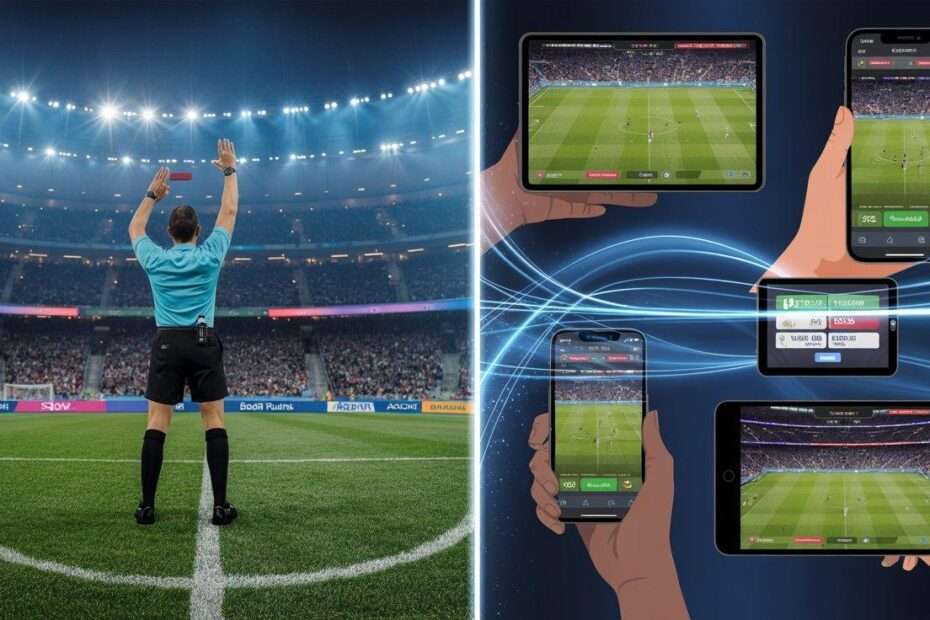
Video technology in sport gets talked about like it’s one thing. It isn’t.
By 2026, most systems fall into two clear groups. Some make decisions on their own, instantly, without a referee stepping in. Others step in only when something isn’t obvious and leave the final call to a human.
That split sounds simple. It isn’t always obvious when you’re watching it unfold.
When the answer can be measured, machines take over
Some calls don’t need interpretation. They just need precision.
Tennis is the cleanest example. Electronic line calling systems like Hawk-Eye are designed for a single question: did the ball land in or out? That’s it. No context, no intent, no debate.
Wimbledon moved to electronic line calling across all match courts last year. Once the system tracks the ball and calculates its landing point, the decision is made. Instantly. No discussion.
It works because the problem is narrow.
If the sport can define the question clearly enough, the system can answer it without hesitation.
When things get messy, video steps in
Other situations don’t fit into that kind of framework.
Football’s VAR system exists because not every decision can be reduced to a line or a point. The rules themselves allow for interpretation, whether it’s a foul, a handball, or a red card.
The official protocol makes this clear. VAR is there for “clear and obvious errors” or serious missed incidents. It doesn’t replace the referee. It supports them.
The same pattern shows up in the NFL. Instant Replay can step in to correct certain factual elements of a play, especially when the video evidence is clear. But it doesn’t take over the entire decision-making process.
There’s always a line where the system stops and the referee steps back in.
Tennis now runs both systems side by side
Tennis ended up in an interesting place.
Line calls are now automated. No argument there. But the sport still has situations that don’t fit neatly into that system, things like whether the ball bounced twice, or whether it touched a player before crossing.
Wimbledon confirmed this year that those calls will be handled through video review on the main courts. A player challenges, the replay comes up, the umpire watches it back and decides from there.
In the same match, it can switch without warning. One call is immediate, over before anyone reacts. The next pauses everything while it’s checked again.
The real difference isn’t the camera
It’s easy to think all of this is about better cameras or more angles. That’s only part of it.
The real difference is what the sport is asking the system to do.
If the question is objective, something that can be measured precisely, automation tends to take over. If the question depends on context, timing, or interpretation, video becomes a tool rather than the decision-maker.
That’s why one sport can fully automate line calls and still rely on human review for other incidents in the same match.
The camera sees everything. It just doesn’t answer everything.
Why the debates don’t go away
There’s still a mismatch between what people think these systems do and what they’re actually there for.
From the stands or on TV, it feels straightforward. The footage is there, you can rewind it, slow it down. It looks like it should answer everything.
And yet, it doesn’t.
Some are about interpretation. Contact. Intent. Timing. And those don’t always translate cleanly, even with multiple angles and slow motion.
You end up with a strange situation. The technology improves, but the arguments don’t disappear. Sometimes they get louder.
Most sports now mix both approaches
The direction is pretty clear at this point.
Sports aren’t choosing between automation and replay. They’re combining them.
Objective decisions move toward full automation. Subjective ones stay with officials, supported by video when needed.
The NFL expanding replay assistance in recent seasons fits that pattern. So does tennis introducing video review alongside automated line calling.
Different sports, same logic.
Where this shows up beyond the field
These systems aren’t operating in a bubble anymore. The moment something happens, it’s replayed, clipped, passed around almost instantly.
That changes how those calls are felt, not just in the stadium, but for anyone watching from somewhere else. Timing matters more. Clarity matters more.
It also affects adjacent spaces tied to live sport, including sports betting in the Middle East, where split-second decisions and confirmed calls feed directly into how moments are interpreted and reacted to in real time.
Even small delays feel different now.
What 2026 makes easier to see
By now, the pattern is hard to miss.
Some decisions can be handed over to machines because they’re precise and measurable. Others still need a referee, even if the camera is showing everything from ten angles.
That’s not a flaw. It’s just the nature of the decisions being made.
And once you start noticing which is which, you stop expecting the system to do something it was never built for, especially when a replay looks clear at first glance but still ends with the referee standing there, thinking for a second longer than anyone expected.
You Also Like To Read: AC Milan vs SSC Bari Timeline: Complete Match History & Stats 2026