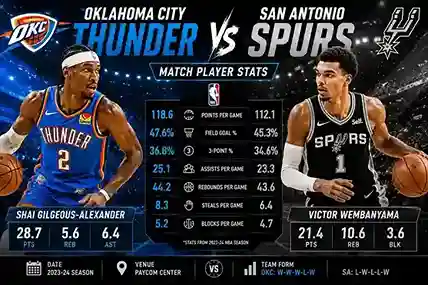
The Western Conference Finals came down to a single elimination game, and the oklahoma city thunder vs san antonio spurs match player stats from Game 7 tell a story of veteran poise, championship DNA, and a young Spurs squad that refused to blink on the road. When the final buzzer sounded at Paycom Center, it was San Antonio celebrating a 111-103 victory that punched their ticket to the NBA Finals.
For the defending champion Thunder, the numbers reveal a bitter ending to a historic season. For the Spurs, the box score validates what everyone witnessed—a complete team performance orchestrated by a generational talent and a supporting cast that stepped up when it mattered most.
Intro
Headline: oklahoma city thunder vs san antonio spurs match player stats: Shai Gilgeous-Alexander’s 35-Point Masterpiece Not Enough as Spurs Clinch Finals Berth in Game 7 Thriller
The San Antonio Spurs delivered a stunning upset on Saturday night, knocking off the defending champion Oklahoma City Thunder 111-103 in Game 7 of the 2026 Western Conference Finals at Paycom Center. Playing before a sold-out crowd of 18,203, the Spurs bucked heavy odds to win a decisive Game 7 on the road, advancing to the NBA Finals for the first time since 2014.
Victor Wembanyama led a balanced Spurs attack with 22 points and 7 rebounds, while Julian Champagnie caught fire from deep with 20 points on 6-of-10 shooting from three-point range. Shai Gilgeous-Alexander poured in a game-high 35 points with 9 assists and 3 steals, but Oklahoma City’s supporting cast failed to provide enough firepower against a San Antonio squad that shot 43% from beyond the arc as a team.
2. Match Overview Table
| Information | Match Details |
| Event | NBA Western Conference Finals – Game 7 |
| Game | San Antonio Spurs vs Oklahoma City Thunder |
| Date | May 30, 2026 |
| Venue | Paycom Center, Oklahoma City, Oklahoma |
| Attendance | 18,203 (sellout) |
| Winner | San Antonio Spurs |
| Final Score | Spurs 111, Thunder 103 |
| Broadcast | NBC, Peacock |
3. Core Match Statistics Overview
The oklahoma city thunder vs san antonio spurs match player stats reveal a game defined by San Antonio’s superior shooting efficiency and ball movement. The Spurs controlled the tempo from the opening tip, building a 32-25 first-quarter lead and never allowing Oklahoma City to seize momentum for extended stretches.
Team Stats Comparison
| Category | San Antonio Spurs | Oklahoma City Thunder |
| Field Goals % | 45.5% (40-88) | 44.6% (37-83) |
| 3-Point % | 42.5% (17-40) | 34.3% (12-35) |
| Free Throws % | 73.7% (14-19) | 77.3% (17-22) |
| Total Rebounds | 40 | 38 |
| Assists | 21 | 23 |
| Turnovers | 12 | 14 |
| Steals | 9 | 9 |
| Blocks | 2 | 5 |
| Offensive Rebounds | 15 | 10 |
| Defensive Rebounds | 25 | 28 |
Three-Point Shooting: The Decisive Margin
San Antonio’s 42.5% clip from deep dwarfed Oklahoma City’s 34.3% mark. The Spurs connected on five more three-pointers than the Thunder, a 15-point swing that proved insurmountable. Julian Champagnie’s 6-of-10 performance from beyond the arc was the game’s most devastating individual shooting display.
Ball Movement and Offensive Flow
Despite missing primary playmaker De’Aaron Fox for stretches due to foul trouble, the Spurs generated 21 assists on 40 made field goals—a 52.5% assist rate. Oklahoma City actually recorded more total assists (23), but San Antonio’s assists were more evenly distributed across the starting lineup, making their offense harder to predict and defend.
Rebounding Battle
The Spurs controlled the glass with a 40-38 edge in total rebounds, but more critically, they grabbed 15 offensive boards to the Thunder’s 10. Those extra possessions translated into second-chance points that kept Oklahoma City from ever building a sustained run.
4. Period-by-Period Analysis
Quarter-by-Quarter Score Breakdown
| Period | San Antonio Spurs | Oklahoma City Thunder |
| 1st Quarter | 32 | 25 |
| 2nd Quarter | 24 | 28 |
| 3rd Quarter | 24 | 24 |
| 4th Quarter | 31 | 26 |
| Final | 111 | 103 |
1st Quarter: Spurs Strike First
- San Antonio exploded for 32 points in the opening frame, with Stephon Castle scoring 9 quick points and Wembanyama adding 5.
- The Thunder’s starting lineup struggled to find rhythm, managing only 25 points as Chet Holmgren and Isaiah Hartenstein combined for just 4 points in the period.
- San Antonio’s 7-point lead after one quarter established the psychological advantage they would carry throughout the night.
2nd Quarter: Thunder Fight Back
- Oklahoma City outscored the Spurs 28-24 in the second, cutting the halftime deficit to just 56-53.
- Shai Gilgeous-Alexander began asserting himself, attacking the rim and drawing fouls to keep the Thunder within striking distance.
- The Spurs’ bench provided a spark with Dylan Harper contributing quality minutes, but San Antonio’s starters cooled off slightly from their scorching first-quarter pace.
3rd Quarter: Stalemate
- Both teams traded baskets in a 24-24 third quarter, with neither side able to generate significant separation.
- Defensive intensity ratcheted up as both teams understood the gravity of the moment. The Thunder forced multiple Spurs turnovers, but San Antonio’s half-court execution remained steady.
- Wembanyama picked up his fourth foul late in the quarter, forcing Spurs coach Gregg Popovich to sit his star for the final minutes—a gamble that paid off as San Antonio’s bench maintained the lead.
4th Quarter: Spurs Close It Out
- The Thunder’s dreams of a comeback were dashed when San Antonio scored 31 points in the fourth quarter, their highest total of the evening.
- Wembanyama returned with fresh legs and delivered 5 critical points in the final frame, including a clutch three-pointer that extended the Spurs’ lead to double digits.
- Gilgeous-Alexander scored 12 points in the fourth, but Oklahoma City’s defense couldn’t get the stops needed to complete the rally.
5. Detailed Team Player Statistics
San Antonio Spurs Player Statistics
Starters
| Player | MIN | PTS | FG | 3PT | FT | REB | AST | STL | BLK | TO | +/- |
| Victor Wembanyama | 41:54 | 22 | 7-15 | 3-5 | 5-7 | 7 | 2 | 1 | 1 | 1 | +7 |
| Julian Champagnie | 37:30 | 20 | 6-11 | 6-10 | 2-3 | 6 | 1 | 1 | 0 | 1 | +16 |
| Stephon Castle | 35:44 | 16 | 7-15 | 0-3 | 2-3 | 6 | 6 | 1 | 0 | 6 | +1 |
| De’Aaron Fox | 35:40 | 15 | 6-12 | 3-7 | 0-0 | 0 | 5 | 3 | 0 | 2 | +3 |
| Devin Vassell | 33:24 | 11 | 4-14 | 1-6 | 2-2 | 6 | 3 | 2 | 0 | 0 | 0 |
Reserves
| Player | MIN | PTS | REB | AST | STL | BLK |
| Dylan Harper | 27:03 | 12 | 7 | 3 | 0 | 0 |
| Keldon Johnson | 16:12 | 11 | 3 | 1 | 1 | 0 |
| Luke Kornet | 6:06 | 2 | 4 | 0 | 0 | 1 |
Victor Wembanyama delivered a composed, mature performance under immense pressure. Despite foul trouble that limited his aggressiveness on the defensive end, the French phenom still produced 22 points, 7 rebounds, and hit 3-of-5 from downtown. His ability to stretch the floor forced Oklahoma City’s big men away from the basket, opening driving lanes for his teammates.
Julian Champagnie was the unsung hero of Game 7. His 6 three-pointers came at crucial moments, and his +16 plus-minus led all players. Every time the Thunder threatened to make a run, Champagnie answered with a dagger from deep.
Stephon Castle filled the stat sheet with 16 points, 6 rebounds, and 6 assists. His 6 turnovers were a blemish, but his physicality and playmaking were essential in orchestrating San Antonio’s offense when Fox was on the bench.
Oklahoma City Thunder Player Statistics
Starters
| Player | MIN | PTS | FG | 3PT | FT | REB | AST | STL | BLK | TO | +/- |
| Shai Gilgeous-Alexander | 42:58 | 35 | 12-21 | 2-5 | 9-11 | 4 | 9 | 3 | 1 | 3 | -7 |
| Cason Wallace | 36:13 | 17 | 6-10 | 5-9 | 0-0 | 7 | 4 | 2 | 1 | 2 | -3 |
| Chet Holmgren | 32:49 | 4 | 1-2 | 0-0 | 2-4 | 4 | 0 | 2 | 2 | 2 | -3 |
| Isaiah Hartenstein | 20:37 | 7 | 3-7 | 0-0 | 1-1 | 5 | 0 | 1 | 0 | 2 | -14 |
| Luguentz Dort | 15:50 | 3 | 1-4 | 1-3 | 0-0 | 2 | 0 | 0 | 0 | 2 | -9 |
Reserves
| Player | MIN | PTS | REB | AST | STL | BLK |
| Alex Caruso | 38:35 | 12 | 5 | 4 | 0 | 1 |
| Jaylin Williams | 25:34 | 11 | 10 | 4 | 0 | 0 |
| Jared McCain | 23:04 | 12 | 1 | 0 | 1 | 0 |
Shai Gilgeous-Alexander was nothing short of spectacular in defeat. His 35 points, 9 assists, 4 rebounds, 3 steals, and 1 block represent one of the great Game 7 performances in recent memory. He shot 12-of-21 from the field and got to the line 11 times. The current MVP did everything in his power to support his squad, but the difficulties faced by the supporting cast were too great to overcome.
Cason Wallace provided a spark with 17 points on 6-of-10 shooting, including 5-of-9 from three. His 7 rebounds and 4 assists made him Oklahoma City’s second-most impactful player, but he couldn’t replicate his production in the critical fourth quarter.
Chet Holmgren had a night to forget. The Thunder’s promising big man managed just 4 points on 1-of-2 shooting in nearly 33 minutes. His inability to punish San Antonio’s defense allowed the Spurs to focus their attention on Gilgeous-Alexander without fear of interior punishment.
6. Statistical Leaders Summary Table
| Category | San Antonio Spurs | Oklahoma City Thunder |
| Leading Scorer | Victor Wembanyama (22) | Shai Gilgeous-Alexander (35) |
| Second Leading Scorer | Julian Champagnie (20) | Cason Wallace (17) |
| Top Rebounder | Victor Wembanyama (7) | Jaylin Williams (10) |
| Most Assists/Playmaker | Stephon Castle (6) | Shai Gilgeous-Alexander (9) |
7. Analytical Breakdowns
Why San Antonio Won
Elite Three-Point Shooting
The Spurs’ 42.5% three-point shooting was the single most decisive factor in Game 7. San Antonio connected on 17 triples to Oklahoma City’s 12, a 15-point advantage that effectively neutralized Gilgeous-Alexander’s individual brilliance.
| Three-Point Shooting | Spurs | Thunder |
| 3PM | 17 | 12 |
| 3PA | 40 | 35 |
| 3PT % | 42.5% | 34.3% |
Balanced Scoring Attack
Five Spurs scored in double figures, while only four Thunder players reached that mark. More importantly, San Antonio’s scoring was distributed across starters and reserves alike, making it impossible for Oklahoma City’s defense to key in on any single player.
| Scoring Distribution | Spurs | Thunder |
| Players with 10+ Points | 5 | 4 |
| Bench Points | 25 | 35 |
| Starter Points | 86 | 68 |
Offensive Rebounding Dominance
San Antonio grabbed 15 offensive rebounds compared to Oklahoma City’s 10. Those five extra possessions allowed the Spurs to maintain possession, control the pace, and prevent the Thunder from generating transition offense off defensive rebounds.
Why Oklahoma City Lost
Heavy Dependence on Shai Gilgeous-Alexander
Gilgeous-Alexander accounted for 35 of Oklahoma City’s 103 points—34% of the team’s total offensive output. When he wasn’t scoring or assisting, the Thunder’s offense stagnated. The supporting cast combined for just 68 points on 25-of-62 shooting (40.3%).
Chet Holmgren’s Invisible Night
Holmgren’s 4 points on 1-of-2 shooting was a catastrophic underperformance for a player expected to be a co-star. His inability to score forced the Thunder to rely on perimeter shooting, and when those shots weren’t falling, Oklahoma City had no interior counterpunch.
| Holmgren Impact | Game 7 Stats |
| Points | 4 |
| Field Goals | 1-2 |
| Rebounds | 4 |
| Minutes | 32:49 |
Turnovers in Critical Moments
The Thunder committed 14 turnovers, several of which came during San Antonio runs in the fourth quarter. Those miscues prevented Oklahoma City from building the momentum needed to overcome the Spurs’ hot shooting.
8. Historical Context & Advanced Insights
Season Series Breakdown
| Date | Matchup | Result | Score |
| Dec. 13, 2025 | Spurs vs Thunder (NBA Cup) | Spurs Win | 111-109 |
| Dec. 23, 2025 | Spurs vs Thunder | Spurs Win | 130-110 |
| May 20, 2026 | WCF Game 2 | Thunder Win | 122-113 |
| May 26, 2026 | WCF Game 5 | Thunder Win | 127-114 |
| May 30, 2026 | WCF Game 7 | Spurs Win | 111-103 |
The Thunder entered the postseason with a 1-4 regular-season record against the Spurs, a troubling statistic that foreshadowed their eventual demise. Despite winning Games 2 and 5 of the Western Conference Finals, Oklahoma City could never solve the Spurs’ matchup problems over the course of a seven-game series.
Advanced Statistical Insights
The Spurs’ offensive rating of 122.4 in Game 7 was elite-level efficiency, particularly given the defensive pressure of a winner-take-all contest. San Antonio’s effective field goal percentage of 55.1% reflects their ability to generate high-quality looks from beyond the arc and at the rim.
Oklahoma City’s assist-to-field-goal ratio of 62.2% (23 assists on 37 made field goals) was actually superior to San Antonio’s 52.5% (21 assists on 40 made field goals). However, the Spurs’ assists were more concentrated among their primary playmakers, creating a more predictable yet efficient offensive structure.
The Thunder’s turnover rate of 13.1% was slightly higher than San Antonio’s 11.1%, but the timing of those turnovers proved devastating. Oklahoma City’s fourth-quarter giveaways directly led to Spurs transition baskets that extended the lead beyond reach.
9. Game Implications & Key Lessons
What This Means for San Antonio Spurs
- The Spurs advance to the NBA Finals for the first time since 2014, validating the franchise’s patient rebuild around Victor Wembanyama.
- San Antonio’s 1-4 regular-season record against Oklahoma City proved irrelevant in the playoffs—this team elevates when the stakes are highest.
- The bench contributions from Dylan Harper (12 points) and Keldon Johnson (11 points) provide confidence that the Spurs have the depth to compete for a championship.
What This Means for Oklahoma City Thunder
- The defending champions face an offseason of soul-searching after failing to defend their title. The supporting cast around Gilgeous-Alexander must improve.
- Chet Holmgren’s 4-point performance raises questions about his readiness to be a reliable second option in high-pressure playoff games.
- Oklahoma City’s 75-22 record in 2025-26 will be remembered as a dominant regular season that ended in crushing playoff disappointment.
Key Lessons from Game 7
- Three-point shooting variance can decide elimination games—San Antonio’s 42.5% clip was the difference-maker.
- Championship experience matters: the Spurs’ poise in a hostile road environment was palpable throughout the fourth quarter.
- One superstar cannot carry a team through a Game 7 against a balanced opponent—Gilgeous-Alexander’s 35 points weren’t enough.
- Offensive rebounding is a playoff superpower; the Spurs’ 15 offensive boards extended possessions and killed Thunder momentum.
- Foul trouble management is critical: Wembanyama played through four fouls and still delivered down the stretch.
- Role players who step up in big moments define championship teams—Julian Champagnie’s 20 points exemplify this truth.
Frequently Asked Questions
Who won the Oklahoma City Thunder vs San Antonio Spurs Game 7?
The San Antonio Spurs defeated the Oklahoma City Thunder 111-103 in Game 7 of the 2026 Western Conference Finals on May 30, 2026. The Spurs won the series 4-3 and advanced to the NBA Finals.
What were Shai Gilgeous-Alexander’s stats in Game 7?
Shai Gilgeous-Alexander scored a game-high 35 points on 12-of-21 shooting, adding 9 assists, 4 rebounds, 3 steals, and 1 block in 43 minutes of action.
What were Victor Wembanyama’s stats in Game 7?
Victor Wembanyama recorded 22 points, 7 rebounds, 2 assists, 1 steal, and 1 block in 42 minutes. He shot 7-of-15 from the field and 3-of-5 from three-point range.
Where was the Thunder vs Spurs Game 7 played?
The game was played at Paycom Center in Oklahoma City, Oklahoma, with an attendance of 18,203 fans.
What was the final score of Game 7 between the Thunder and Spurs?
The final score was San Antonio Spurs 111, Oklahoma City Thunder 103.
How did the Spurs win Game 7 on the road?
The Spurs won behind balanced scoring (five players in double figures), elite three-point shooting (17-of-40, 42.5%), and dominant offensive rebounding (15 offensive boards).
Conclusion
The oklahoma city thunder vs san antonio spurs match player stats from Game 7 paint a clear picture: efficiency and teamwork outperformed individual brilliance. Shai Gilgeous-Alexander delivered a heroic 35-point, 9-assist masterpiece, but the Thunder’s supporting cast—particularly Chet Holmgren’s 4-point outing—could not match San Antonio’s collective firepower.
The Spurs’ 42.5% three-point shooting, 15 offensive rebounds, and five double-figure scorers were the statistical pillars of their victory. Victor Wembanyama’s 22 points and 7 rebounds were solid, but it was Julian Champagnie’s 20-point explosion and the team’s poise in critical moments that truly defined this win.
San Antonio now advances to the NBA Finals with momentum and confidence, while Oklahoma City faces an offseason of reflection. In the end, the box score confirms what the eyes witnessed: the Spurs were simply the better team on the night that mattered most.