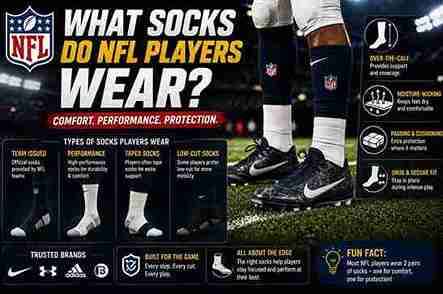
NFL players wear specific performance socks that incorporate moisture-wicking fabrics, compression technology, and stringent covering regulations set by the league. From the sock length regulations that have fined superstars like Tyreek Hill and JuJu Smith-Schuster to the advanced fabric blends that prevent blisters and enhance blood flow, this deep dive reveals exactly what goes into the socks worn by professional football athletes.
Introduction
The NFL’s sock rules aren’t just about fashion—they’re rooted in a 1945 mandate from then-Commissioner Elmer Layden, who famously deemed players had “unsightly legs” that needed covering. That decree evolved into the league’s current uniform policy, which requires stockings to “cover the entire area from the shoe to the bottom of the pants, and must meet the pants below the knee”. Today, what socks do NFL players wear has become a multimillion-dollar question involving advanced textile engineering, position-specific designs, and strict compliance enforcement.
The socks worn by NFL players are far from ordinary. They’re constructed from performance-driven materials like nylon, polyester, spandex, and specialized cotton-blends, engineered to provide compression, moisture management, and impact protection. Modern players typically layer two types of socks: a base compression sock against the skin, followed by a performance sock that provides cushioning and the signature “scrunch” look popularized by stars like Odell Beckham Jr..
NFL Sock Regulations Overview
| Information | Match Details |
| Event | National Football League Uniform Policy |
| Game | NFL Regular Season & Postseason |
| Date | Policy enacted 1945, updated continuously |
| Venue | All NFL Stadiums |
| Enforcement | League-wide uniform inspections |
| Penalty | Fines up to $10,500+ per violation |
| Broadcast | All NFL network broadcasts |
Core Sock Specifications Overview
| Specification | Requirement/Standard |
| Coverage Length | From shoe top to bottom of pants, meeting below knee |
| Color Rules | Previously white to mid-calf + team color above; now solid color permitted |
| Material Composition | Nylon, polyester, spandex, cotton-blend |
| Compression Level | Typically 10-30 mmHg graduated compression |
| Padding Zones | Heel, toe, arch, Achilles areas |
| Layering | Base layer + performance sock + optional calf sleeve |
Coverage Requirements
The NFL’s sock rules are non-negotiable. “Skin exposure of the lower leg and ankle area owing to incorrect wear of game socks and/or leg covers is prohibited at all times throughout the game,” the rulebook says. Players are permitted to wear multiple layers of socks and tape on the lower leg, provided the exterior meets uniform standards.
Material Science
NFL socks utilize advanced synthetic blends to maximize performance. Polyester and nylon provide superior moisture-wicking properties, drawing sweat away from the skin to prevent blisters. Spandex or elastane delivers the compression fit that supports arches and ankles. Some manufacturers incorporate Cordura nylon in high-wear areas like heels and toes for enhanced durability.
Position-by-Position Sock Analysis
| Position | Typical Sock Setup | Key Features |
| Quarterback | Base layer + light compression | Flexibility, light cushioning |
| Wide Receiver | Base + performance + calf sleeves | Maximum mobility, ankle support |
| Running Back | Heavy cushioning + ankle protection | Impact absorption, stability |
| Offensive Lineman | Maximum padding + arch support | Durability, sustained comfort |
| Linebacker | Mid-compression + reinforced zones | Balance of support and agility |
| Defensive Back | Lightweight + high compression | Speed, reduced muscle fatigue |
Quarterbacks & Skill Positions
Quarterbacks and skill-position players prioritize mobility and feel. Patrick Mahomes and other modern quarterbacks typically wear ankle or quarter-length socks combined with compression calf sleeves. This setup provides the required coverage while maintaining the freedom of movement needed for passing and scrambling.
Linemen & High-Impact Positions
Offensive and defensive linemen require maximum cushioning and durability. These players experience constant high-impact collisions and need socks with reinforced heel and toe areas to withstand repeated stress. Extra padding in the arch and Achilles zones helps prevent injuries during the sustained pushing and blocking that defines line play.
Material Composition Breakdown
| Material | Primary Function | Typical Percentage |
| Polyester | Moisture-wicking, durability | 70-95% |
| Nylon | Stretch, conforming fit | 2-15% |
| Spandex/Elastane | Compression, shape retention | 1-5% |
| Rubber | Grip, durability | 1-5% |
| Cotton (limited) | Comfort, softness | 0-10% |
Moisture Management
The synthetic fibers in NFL socks actively manage sweat, keeping feet dry throughout four quarters of intense physical exertion. This moisture-wicking capability is critical for blister prevention and temperature regulation, especially during games played in extreme weather conditions.
Compression Technology
Compression levels in NFL socks typically range from 10-30 mmHg. Higher compression (20-30 mmHg) enhances venous return, facilitating the removal of metabolic waste from muscle tissue. This graduated pressure helps reduce muscle fatigue and accelerates recovery between plays.
Fine History & Enforcement
| Player | Fine Amount | Year | Violation |
| Frank Gore | $10,500 | 2013 | Socks worn too low |
| JuJu Smith-Schuster | $5,000 | 2020 | Socks below knee |
| James Conner | $5,000 | 2020 | Socks below knee |
| Tyreek Hill | ~$100,000+ | 2023 | Multiple uniform violations |
The NFL enforces its sock regulations strictly. Frank Gore famously received a $10,500 fine for wearing his socks too low, later commenting, “When you’re playing, you don’t think about it. You’re trying to win”. More recently, Tyreek Hill has faced repeated fines totaling less than $100,000 for uniform and sock policy violations.
Historical Context & Rule Evolution
The 1945 Mandate
In 1945, Commissioner Elmer Layden implemented the rule requiring players to cover their legs. The stated reason was aesthetic—Layden considered players’ legs “unsightly”—but the rule has persisted for nearly eight decades, evolving into a comprehensive uniform policy that prioritizes both appearance and professionalism.
The 2019 Color Rule Change
Previously, NFL rules required stockings to be white from the top of the shoe to mid-calf and an approved team color from mid-calf to the bottom of the pant leg. In 2019, the league adjusted this policy to allow solid-color stockings. The Cleveland Browns have taken the most advantage of this change, wearing solid orange, brown, and white combinations.
Modern Innovations
Today’s NFL socks represent significant technological advancement. Manufacturers like WaltUSA produce socks specifically for NFL teams, with production processes that include weighing, washing, pressing, and branding with the official NFL logo. Brands like Nike, Nxtrnd, and For Bare Feet compete to supply players with cutting-edge sock technology.
Statistical Leaders: Most Fined Players for Sock Violations
| Category | Player Name | Total Fines (Estimated) |
| Most Sock Violations | Tyreek Hill | ~$100,000+ |
| Single Largest Fine | Frank Gore | $10,500 |
| Notable Repeat Offender | JuJu Smith-Schuster | $5,000+ |
| Highest-Profile Fine | James Conner | $5,000 |
Why the NFL Enforces Sock Rules / Why Players Push Back
Why the League Enforces Strict Rules
Uniformity and Professional Image
The NFL’s five-page uniform policy exists to convey professionalism. The league believes players’ appearance directly affects the NFL’s reputation and commercial success. Sock compliance ensures a consistent, polished look across all 32 teams.
Safety Considerations
While the original 1945 rule was aesthetic, modern enforcement incorporates safety elements. Proper sock coverage protects players from turf burns, abrasions, and exposure to extreme weather conditions.
Why Players Challenge the Rules
Comfort and Performance Preferences
Many players prefer lower socks for comfort and freedom of movement. Frank Gore’s $10,500 fine came from a player focused on winning, not fashion. The tension between league aesthetics and player performance continues to drive violations.
The “Scrunch” Trend
The popular “scrunch” look—where socks are bunched around the ankle—has become a style statement among players. While technically compliant when combined with leg coverings, this trend pushes the boundaries of the uniform policy.
Game Implications & Key Lessons
What This Means for Players
- Financial risk: Sock violations can cost players thousands of dollars per infraction, with repeat offenders facing cumulative fines exceeding $100,000
- Performance trade-offs: Players must balance personal comfort preferences against league compliance requirements
- Position-specific needs: Different positions require different sock configurations for optimal performance
What This Means for Fans
- Understanding the game: Recognizing that what socks do NFL players wear is a strategic equipment choice, not just a fashion decision
- Replica accuracy: Official team socks sold to fans mirror the materials and designs worn by players
- Appreciation of technology: The advanced textile engineering in NFL socks represents significant sports science innovation
Key Lessons
- NFL players typically wear two layers: a base compression sock and a performance sock
- Sock materials prioritize moisture-wicking synthetic fibers like polyester and nylon
- Compression levels of 10-30 mmHg enhance blood circulation and reduce muscle fatigue
- Sock violations have resulted in fines exceeding $10,500 for individual players
- The 1945 mandate requiring full leg coverage remains in effect nearly 80 years later
- Position-specific needs determine optimal sock configuration—linemen require more padding than skill-position players
Frequently Asked Questions
What socks do NFL players wear during games?
NFL players wear specialized performance socks made from synthetic blends of polyester, nylon, and spandex. Most players layer a base compression sock with a performance sock for optimal cushioning and support.
Why are long socks required for NFL players?
The NFL requires long socks due to a 1945 rule by Commissioner Elmer Layden. Current regulations mandate that socks must cover the entire area from the shoe to the bottom of the pants and meet the pants below the knee.
What happens if an NFL player wears socks too low?
Players who wear socks too low face fines from the NFL. Frank Gore received a $10,500 fine in 2013, while JuJu Smith-Schuster and James Conner were each fined $5,000 in 2020 for similar violations.
Do NFL players wear compression socks?
Yes, many NFL players wear compression socks as a base layer. Compression levels typically range from 10-30 mmHg and help improve blood circulation, reduce muscle fatigue, and accelerate recovery.
What materials are NFL socks made from?
NFL socks are primarily made from polyester (70-95%), nylon (2-15%), and spandex (1-5%). Some socks also incorporate rubber for grip and durability. These synthetic materials provide moisture-wicking properties and compression benefits.
Why do NFL players wear two pairs of socks?
Wearing two pairs of socks—a base layer and a performance sock—provides additional cushioning, blister prevention, and allows players to comply with uniform rules while maintaining comfort. The base layer manages moisture while the outer sock provides impact protection.
Conclusion
What socks do NFL players wear is a question with surprisingly complex answers. From the 1945 mandate that started it all to today’s advanced compression technology, NFL socks represent a critical intersection of tradition, performance, and league politics. The synthetic blends of polyester, nylon, and spandex deliver moisture management and support that prevent blisters and reduce fatigue. The two-layer system—base compression sock plus performance sock—provides the cushioning and protection needed for the sport’s violent impacts. And the strict enforcement, with fines reaching five figures, ensures players comply with regulations that have defined the league’s aesthetic for nearly eight decades. Whether you’re a player looking to optimize your gear or a fan wanting to understand the game at a deeper level, the socks worn by NFL athletes reveal just how much technology and strategy go into every aspect of professional football.