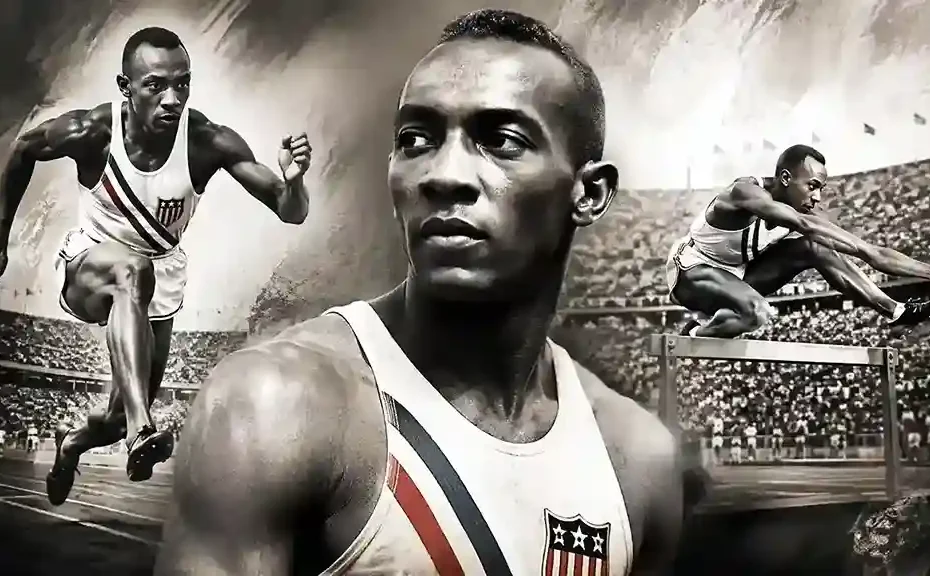
Most people know Jesse Owens won gold at the 1936 Berlin Olympics, yet few can name the small Alabama town where his story began or the park that now honors it. That gap leaves a rich piece of American history overlooked. This guide closes that gap. Here, you will learn Jesse Owens’ full journey, from a sharecropper’s cabin in Oakville to Olympic glory, plus everything you need to plan a visit to his memorial park.
Who Was Jesse Owens? A Quick Answer
American track and field competitor Jesse Owens took home four gold medals at the 1936 Summer Olympics in Berlin. Born James Cleveland Owens in Oakville, Alabama, on September 12, 1913, he set world records in the 100-meter dash, the long jump, and the 4×100-meter relay.<cite index=”19-1″>His Olympic victories were a blow to Adolf Hitler’s intention to use the Games to demonstrate Aryan superiority.</cite>
He grew up in poverty, studied at Ohio State University, and became one of the most celebrated athletes of the twentieth century. Today, his birthplace in Oakville hosts a museum and public park built in his honor.
Early Life: From Oakville, Alabama to Cleveland, Ohio
Jesse Owens was <cite index=”17-1″>born near Oakville, Alabama, on September 12, 1913, one of the youngest children of sharecroppers Henry and Mary Emma Owens</cite>. Farm work in rural Alabama was hard, and frequent illness kept young Owens away from the fields more often than his family could afford.
<cite index=”14-1″>The family moved to Cleveland, Ohio, when Owens was nine years old in search of steadier work</cite>. A grade-school teacher misheard his nickname “J.C.” as “Jesse,” and the name stuck for the rest of his life.
In Cleveland, Owens found a coach who changed everything.
- He joined the track team at Fairview Junior High School.
- Coach Charles Riley spotted his raw speed and trained him before school hours.
- He later set national high school records in the sprints and long jump at East Technical High School.
That early coaching turned a sickly farm kid into a rising track star.
Jesse Owens at Ohio State University: The Buckeye Bullet
Jesse Owens enrolled at Ohio State University in 1933, where <cite index=”14-1″>he earned the nickname “the Buckeye Bullet.”</cite> Ohio State did not offer him an athletic scholarship, so he worked part-time jobs to pay for his education while training.
His most remarkable college feat came on May 25, 1935, at the Big Ten Championships in Ann Arbor, Michigan. In roughly 45 minutes, Owens broke three world records and tied a fourth — a single-day performance still regarded as one of the greatest in track and field history.
That afternoon alone made him a household name before he ever reached the Olympic stage.
The 1936 Berlin Olympics: Four Gold Medals That Shocked the World
The 1936 Olympics carried enormous political weight. Adolf Hitler planned to use the Berlin Games to showcase Nazi ideas of racial superiority. Jesse Owens had other plans.
He won four gold medals in front of the German dictator and a global audience:
| Event | Result | Medal |
|---|---|---|
| 100-meter dash | 10.3 seconds | Gold |
| Long jump | 8.06 meters | Gold |
| 200-meter dash | 20.7 seconds (Olympic record) | Gold |
| 4×100-meter relay | 39.8 seconds (world record) | Gold |
<cite index=”20-1″>His four Olympic victories were a direct blow to Adolf Hitler’s intention to use the Games to demonstrate Aryan superiority</cite>, and the moment turned Owens into an international symbol of dignity under pressure.
Jesse Owens vs. Adolf Hitler: Separating Fact From Myth
A popular story claims Hitler personally refused to shake Owens’ hand. The full picture is more nuanced.
- Hitler skipped congratulating several early medalists, not Owens alone, after Olympic officials advised him to either greet every winner or none.
- Owens himself later said the greater snub came at home, where he was never invited to the White House by President Franklin D. Roosevelt.
- German long jumper Luz Long publicly embraced Owens after losing to him, an act of sportsmanship that defied Nazi propaganda.
The friendship between Owens and Long remains one of the most powerful stories of the 1936 Games, and it now anchors part of the exhibit at his memorial park in Alabama.
Life After the Olympics: Struggles and Comebacks
Fame did not translate into financial security for Jesse Owens. Amateur athletics rules of the era barred him from earning money off his own name, so he took jobs that ranged far from the track — including racing against horses for pay.
He later built a public speaking career and worked with youth sports programs in underserved neighborhoods. He also served as a goodwill ambassador for the United States, traveling internationally to promote athletics and youth mentorship.
By the 1960s and 1970s, Jesse Owens had become a respected elder statesman of American sports.
Jesse Owens’ Awards and Honors
Recognition for Jesse Owens grew steadily in the decades after his competitive career ended.
- 1976: President Gerald Ford awarded him the Presidential Medal of Freedom, the nation’s highest civilian honor.
- 1979: He received the Living Legends Award from President Jimmy Carter.
- 1990: President George H. W. Bush posthumously awarded him the Congressional Gold Medal.
- 1984: A street in Berlin was renamed in his honor, four years after his death.
<cite index=”19-1″>Jesse Owens died of lung cancer on March 31, 1980, in Tucson, Arizona, at age 66.</cite> He is buried at Oak Woods Cemetery in Chicago.
Jesse Owens Memorial Park: Often Searched as “Jesse Owens State Park”
Many visitors search for the “Jesse Owens State Park,” but no site carries that exact name. The real destination is the Jesse Owens Memorial Park, a 20-acre site built on his birthplace in Oakville, Lawrence County, Alabama.
<cite index=”1-1″>The park commemorates Jesse Owens as a museum and 20-acre site honoring the Olympic and collegiate track and field star</cite>. Local resident Therman White first proposed the project in 1991, and it took a coordinated fundraising effort to bring it to life.
<cite index=”1-1″>Working with the Alabama Cooperative Extension System and Auburn University, organizers raised more than $2 million for the park’s construction</cite>. Progress stalled until officials convinced the Olympic Torch Committee to reroute the 1996 torch relay through Oakville on its way to Atlanta.
That single decision changed everything for the project.
- Donations increased sharply once the torch route was confirmed.
- Construction finished just days before the torch’s arrival.
- <cite index=”2-1″>Owens’ grandson, Stuart Owen Rankin, carried the torch into the park, and Owens’ widow, Ruth, lit the park’s “eternal flame” on June 29, 1996</cite>.
That dedication day officially opened the Jesse Owens Memorial Park to the public.
What to See at the Jesse Owens Memorial Park and Museum
The park gives visitors a full picture of Owens’ life, not just his Olympic highlight reel. <cite index=”8-1″>Exhibits include a museum, a statue, a replica 1936 Olympic torch, a replica of Owens’ birth home, and an oak tree grown from the same variety as his Olympic “gold medal tree.”</cite>
Inside the museum, three galleries tell distinct parts of his story:
- The Jesse Owens Story Gallery — covers his humble beginnings in Oakville through his college years.
- The Running Gallery — <cite index=”2-1″>focuses on his athletic career with photographs, memorabilia, and replica artifacts, including images of his friendship with German long jumper Luz Long</cite>.
- The Humanitarian Gallery — highlights his post-Olympic advocacy and youth mentorship work.
Outside, families can walk the grounds, view the eternal flame, and see recreational spaces that double as a community park for local Oakville residents.
Planning Your Visit: Hours, Location, and Tips
<cite index=”7-1″>The Jesse Owens Memorial Park sits at 7019 County Road 203 in Oakville, roughly 30 miles northwest of Cullman, Alabama.</cite> <cite index=”7-1″>It is open Monday through Saturday from 10:00 a.m. to 4:00 p.m., and Sundays from 1:00 to 4:00 p.m.</cite>
A few tips help visitors get the most from the trip:
- Set aside one to two hours to see the museum and outdoor exhibits at a comfortable pace.
- Bring kids — the on-site playground and open lawns make it an easy stop for families, not just history buffs.
- Check ahead for seasonal hours or closures around holidays before you drive out.
- Combine the visit with nearby Lawrence County attractions to build a full day trip.
<cite index=”5-1″>Locals describe the park as one of Lawrence County’s most under-known treasures</cite>, which makes it a rewarding stop for travelers who want history without the crowds.
Jesse Owens’ Lasting Legacy in Sports and Civil Rights
The influence of Jesse Owens reaches well past track and field. His 1936 performance became an early, visible rebuttal to state-sponsored racism on a world stage, decades before the American civil rights movement reached its peak.
Modern athletes and historians still reference his story when discussing sportsmanship, national identity, and the courage it takes to compete under hostile conditions. His long jump world record stood for 25 years, and his four-gold-medal Olympic feat went unmatched until Carl Lewis repeated it in 1984.
Entities closely tied to his legacy include the Ohio State Buckeyes track program, the 1936 Berlin Olympics, the Presidential Medal of Freedom, and the Congressional Gold Medal — each a thread connecting his personal story to broader American history.
Jesse Owens Timeline at a Glance
| Year | Milestone |
|---|---|
| 1913 | Born in Oakville, Alabama |
| 1922 | Family relocates to Cleveland, Ohio |
| 1933 | Enrolls at Ohio State University |
| 1935 | Breaks three world records in 45 minutes at the Big Ten Championships |
| 1936 | Wins four gold medals at the Berlin Olympics |
| 1976 | Receives the Presidential Medal of Freedom |
| 1980 | Dies in Tucson, Arizona, at age 66 |
| 1990 | Posthumously awarded the Congressional Gold Medal |
| 1996 | Jesse Owens Memorial Park dedicated in Oakville, Alabama |
Frequently Asked Questions
Who was Jesse Owens, and why is he famous?
Jesse Owens was an American track and field athlete who won four gold medals at the 1936 Berlin Olympics, a feat that challenged Nazi claims of racial superiority.
Where was Jesse Owens born?
He was born in Oakville, Alabama, on September 12, 1913, and later moved to Cleveland, Ohio, as a child.
How many gold medals did Jesse Owens win at the 1936 Olympics?
He won four gold medals: the 100-meter dash, the 200-meter dash, the long jump, and the 4×100-meter relay.
Is there a Jesse Owens State Park?
No official site carries that name. The correct destination is the Jesse Owens Memorial Park in Oakville, Alabama, built on his birthplace.
Where is the Jesse Owens Memorial Park located, and what are its hours?
It sits at 7019 County Road 203 in Oakville, Alabama, and is open Monday through Saturday, 10 a.m. to 4 p.m., and Sundays, 1 p.m. to 4 p.m.
Did Adolf Hitler refuse to shake Jesse Owens’ hand?
Hitler did not personally greet several early medal winners, not Owens alone, after officials advised him to congratulate everyone or no one.
Visit the Home of an American Icon
Jesse Owens turned a childhood shaped by poverty into one of the most celebrated athletic careers in history, and his hometown park keeps that story alive for every visitor who walks through its gates. Plan your trip to the Jesse Owens Memorial Park, walk the grounds where his journey began, and carry his example of quiet, determined excellence into your own goals. History like this deserves to be seen in person, not just read about.