Canelo vs. Crawford
Canelo vs. Crawford: How Terence Crawford Mastered the Fight of the Century
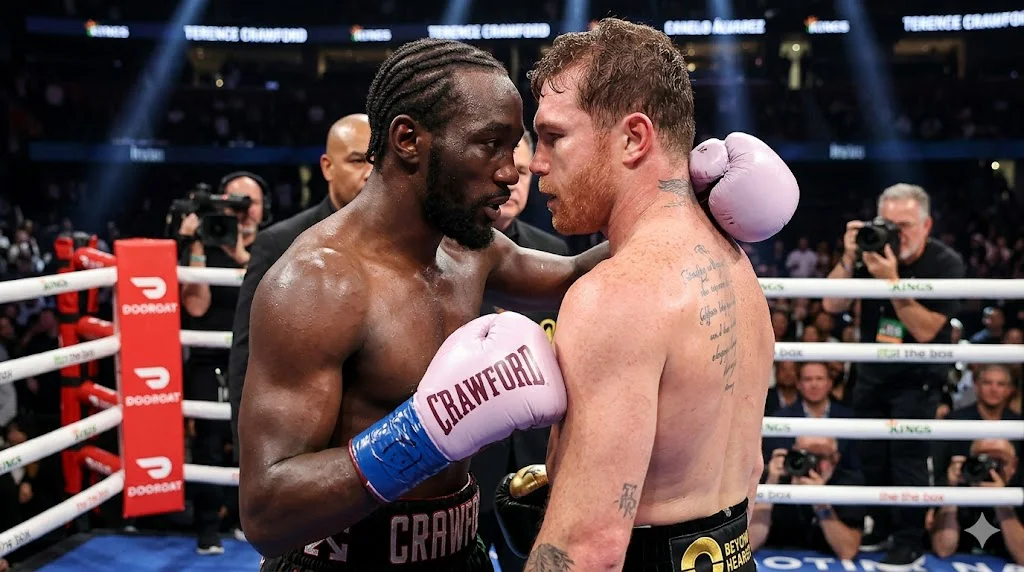
When Terence Crawford stepped through the ropes at Allegiant Stadium on September 13, 2025, he carried the weight of boxing history on his shoulders. Moving up two entire weight classes to challenge the face of the sport, Saul “Canelo” Alvarez, for the undisputed super middleweight championship was a risk few modern fighters would dare take.
By the end of the night, before a record-breaking crowd of over 70,000 fans and a massive global audience streaming live on Netflix, Crawford did not just survive the weight jump. He delivered a boxing masterclass.
Defeating Canelo via a 12-round unanimous decision, Crawford left no doubt about his standing in the sport. He neutralized the natural size, raw power, and relentless pressure of the Mexican icon with precision, lateral movement, and unparalleled ring IQ. This was not a brawl; it was a high-stakes chess match, and Crawford remained two steps ahead from the middle rounds to the final bell.
If there were any lingering debates about the greatest boxer of this era, the Canelo vs. Crawford showdown put them firmly to rest.
The Magnitude of September 13, 2025
Boxing has a long history of overusing the phrase “Fight of the Century,” but the clash between Canelo and Crawford genuinely warranted the moniker. The event, backed by Riyadh Season and promoted in collaboration with TKO, shattered records across the board. It set the all-time single-day live gate record for Allegiant Stadium, pulling in over $47 million, and drew an estimated 41.4 million viewers globally on Netflix, making it the most-watched men’s championship boxing fight of the 21st century.
The stakes were clear. For Canelo Alvarez, this was an opportunity to defend his undisputed throne at 168 pounds against the undisputed king of the lower weight classes, adding a defining victory to an already Hall of Fame-worthy resume.
For Terence Crawford, the goal was unprecedented. Having already conquered the super lightweight and welterweight divisions as an undisputed champion, moving up to super middleweight offered him the chance to become the first male boxer in the four-belt era to hold undisputed status in three different weight classes.
Tale of the Tape: The Physical and Historical Divide
The narrative leading into the fight heavily centered on the physical disparities between the two men. While skill sets were largely viewed as competitive, the physical demands of jumping from 154 pounds to 168 pounds seemed like an insurmountable hurdle for the fighter from Omaha, Nebraska.
Canelo Alvarez: The Super Middleweight King
Entering the bout with a record of 63-2-2 (39 KOs), Canelo was heavily favored due to his natural size and comfort at 168 pounds. He had effectively cleared out the super middleweight division, utilizing a high guard, immense physical strength, and punishing body shots to break down opponents. Canelo had not lost since his excursion to light heavyweight against Dmitry Bivol in 2022, and his chin was widely regarded as one of the most reliable in combat sports. The expectation was that Canelo would walk through Crawford’s punches and eventually break the smaller man down.
Terence Crawford: The Pound-for-Pound Technician
Crawford stepped into the ring with a flawless 41-0 record (31 KOs). Although naturally smaller, Crawford surprisingly held a slight height advantage at 5’8″ compared to Canelo’s 5’7.5″, alongside a crucial four-inch reach advantage (74 inches to 70 inches). Still, frame density and functional strength heavily favored Canelo. Crawford’s path to victory relied entirely on his switch-hitting ability, distance management, and razor-sharp counterpunching. He had to fight a perfect fight, knowing a single lapse in concentration could lead to a devastating knockout.
Tactical Breakdown: How Crawford Outboxed Canelo
The fight itself unfolded as a fascinating clash of styles. It was a classic “bull versus matador” scenario, but the matador brought an unprecedented level of strategic spacing to the ring.
Rounds 1-4: The Feeling-Out Process and Canelo’s Body Attack
The opening frames of the fight were tense and calculated. Canelo took the center of the ring, attempting to establish his jab and cut off the ring. Crawford, fighting primarily out of the southpaw stance, used his legs to maintain distance, peppering Canelo with a fast, disruptive jab.
Canelo found some early success in the second and third rounds by targeting Crawford’s midsection. Utilizing his trademark left hook to the body, Canelo attempted to slow Crawford’s lateral movement. The Mexican champion invested heavily in these early body shots, banking on the idea that the smaller man would eventually tire out under the physical strain. Crawford remained disciplined, absorbing the shots on his guard and elbows while firing back sharp check hooks to keep Canelo honest.
Rounds 5-8: Crawford Finds His Range and Takes Over
The momentum of the fight shifted decisively in the middle rounds, specifically around round six. Crawford later noted that this was the moment he realized he needed to take control of the pacing.
As Canelo continued to march forward, Crawford’s footwork became highly elusive. Instead of retreating in straight lines—a mistake that had cost many of Canelo’s previous opponents dearly—Crawford pivoted off the center line, creating sharp angles. He began catching Canelo cleanly as the champion stepped in. Crawford’s counter uppercuts and straight left hands found their mark repeatedly.
Canelo’s offensive output began to drop as he struggled to figure out Crawford’s spacing. Every time Canelo planted his feet to throw a power combination, Crawford was already out of range, answering with rapid multi-punch flurries before resetting. The size advantage Canelo brought to the ring was entirely negated by his inability to land flush on a moving target.
Rounds 9-12: A Masterclass in Ring Generalship
By the championship rounds, the frustration on Canelo’s face was evident. He needed a knockout to win, but Crawford refused to offer him a stationary target. Crawford dictated the geography of the ring entirely. If Canelo pressured, Crawford circled away and countered. If Canelo paused to reset, Crawford stepped in behind a stiff jab to score points.
Crawford fought with supreme confidence in the final rounds, even flashing a smile after Canelo missed wildly with a heavy right hand. The smaller man never truly hurt Canelo—a testament to Alvarez’s legendary chin—but he completely dismantled him tactically. The final bell rang to a standing ovation from the Las Vegas crowd, recognizing the historic performance they had just witnessed.
The Official Scorecards Explained
When the final bell sounded, the outcome felt inevitable to everyone watching, though the judges’ scorecards were closer than the visual story of the fight suggested.
The three ringside judges scored the bout 116-112, 115-113, and 115-113, awarding Terence Crawford a unanimous decision victory.
While a 115-113 scorecard implies a highly competitive fight (seven rounds to five), the reality inside the ring felt much wider in Crawford’s favor. The tight scoring can likely be attributed to Canelo’s aggression and ring control in the first half of the fight, where he was consistently walking forward and throwing heavier punches, even if many of them landed on Crawford’s gloves. However, from round six onward, Crawford pitched a near shutout, landing the cleaner, more effective punches and completely controlling the pace.
The Aftermath: Respect, Legacy, and Mayweather Comparisons
One of the most defining moments of the night occurred after the scorecards were read. Despite losing his undisputed crown, Canelo Alvarez showed immense grace in defeat.
In the post-fight press conference, Canelo acknowledged Crawford’s brilliance, admitting that the American’s spacing and timing were too much to overcome. “He’s a great champion. He’s a strong competitor,” Canelo said. “I’ve got nothing but respect for Canelo… he fought like a champion today.”
But it was Canelo’s next admission that sent shockwaves through the boxing world. Having shared the ring with an undefeated Floyd Mayweather Jr. back in 2013, Canelo offered a heavy piece of historical context: “I think Crawford is way better than Floyd Mayweather.”
Coming from a fighter who experienced the defensive wizardry of Mayweather firsthand, this quote instantly cemented Crawford’s performance as one of the greatest tactical displays in the history of the sport. Crawford did not just beat Canelo; he out-thought him on a level that left the Mexican legend thoroughly impressed.
What This Victory Means for Terence Crawford’s Legacy
With the victory over Canelo Alvarez, Terence Crawford improved his record to 42-0 and officially achieved something no male boxer had ever done in the modern four-belt era.
The First Three-Division Undisputed Champion
Crawford had already built a Hall of Fame resume by unifying all the belts at 140 pounds and 147 pounds. By capturing the WBC, WBA, WBO, and IBF super middleweight titles at 168 pounds, Crawford unlocked a new tier of greatness.
In the modern era of boxing, where politics, network divides, and promotional rivalries routinely prevent the best from fighting the best, unifying a single division is a massive achievement. Unifying three divisions—especially by jumping two weight classes to dethrone a generational great like Canelo—places Crawford in rarefied air.
His resume now includes dominant victories over Errol Spence Jr. and Canelo Alvarez. He has systematically dismantled the best fighters of his generation across multiple weight classes. The debate over who is the number one pound-for-pound fighter in the world is definitively over. Crawford is not just the best fighter of today; he is firmly in the conversation for the greatest switch-hitter of all time and one of the finest pure boxers to ever lace up a pair of gloves.
Where Does Canelo Alvarez Go From Here?
For Canelo Alvarez, the loss drops his record to 63-3-2, but it does little to tarnish his legacy. Daring to fight the best available challengers has always been Canelo’s calling card. He took a massive commercial and competitive risk by accepting the fight with Crawford, and while he came up short, his willingness to test himself against elite opposition remains his defining trait.
Moving forward, Canelo still holds immense drawing power and remains the biggest financial attraction in the sport. He will likely look to rebuild his momentum at 168 pounds. The division still holds intriguing matches, including highly ranked contenders like Christian Mbilli (who fought to a thrilling draw on the Canelo-Crawford undercard) or a potential move back to 175 pounds for a rematch with Dmitry Bivol.
Canelo’s physical prime may be in the rearview mirror, but his experience, power, and massive global fanbase ensure that his next move will still command the attention of the entire sporting world.
The Impact of Netflix on Boxing’s New Era
Beyond the action in the ring, Canelo vs. Crawford represented a seismic shift in how boxing is consumed globally. By broadcasting the event live to its massive subscriber base without an additional pay-per-view fee, Netflix proved that the traditional PPV model is no longer the only way to stage a mega-fight.
Drawing over 41 million viewers, the platform successfully delivered the sport back to the masses. The accessibility of the fight introduced millions of casual fans to Terence Crawford’s brilliance and showcased the unmatched theater of a top-tier Las Vegas boxing event. Combined with the financial backing of Riyadh Season and the operational expertise of TKO’s Dana White, the structural foundation of boxing has been permanently altered for the better.
Final Thoughts on a Historic Masterpiece
The Canelo vs. Crawford bout delivered everything a boxing purist could ask for. It answered long-standing hypothetical questions about size versus skill and gave fans a definitive conclusion without controversy or debate.
Terence Crawford dared to be great, stepping far outside his natural physical boundaries to chase history. He succeeded through discipline, unparalleled ring intelligence, and flawless execution. Canelo Alvarez played his part perfectly, pressing the action and forcing Crawford to fight at the absolute highest level of his capabilities.
September 13, 2025, will forever be remembered as the night Terence Crawford defied history, solved the Canelo puzzle, and carved his name onto the Mount Rushmore of boxing greats.
Who won the Canelo vs. Crawford fight?
Terence Crawford won the fight via a 12-round unanimous decision on September 13, 2025, claiming the undisputed super middleweight championship.
What were the official scorecards for Canelo vs. Crawford?
The three ringside judges scored the bout 116-112, 115-113, and 115-113, all in favor of Terence Crawford.
Did Terence Crawford knock out Canelo Alvarez?
No, the fight went the full 12 rounds. Crawford won by outboxing Canelo, utilizing superior distance management and counterpunching to secure a unanimous decision.
What weight class was Canelo vs. Crawford?
The bout took place in the super middleweight division with a weight limit of 168 pounds. Crawford moved up two weight classes from 154 pounds to take the fight.
Where was the Canelo vs. Crawford fight held?
The historic mega-fight was held at Allegiant Stadium in Las Vegas, Nevada, and was streamed globally to over 41 million viewers on Netflix.
About the Author