Key Takeaways
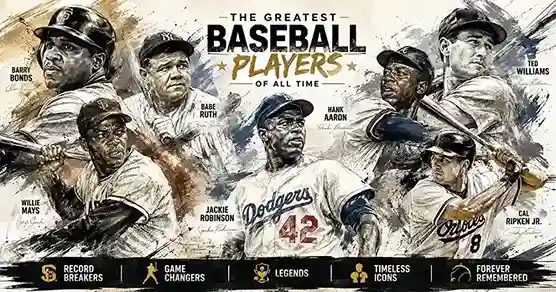
- Babe Ruth, Willie Mays, Hank Aaron, and Barry Bonds anchor most credible all-time rankings, but the exact order depends on whether you weight peak dominance, career totals, or two-way value.
- Career home run leader Barry Bonds (762) sits behind Ruth and Mays on most expert lists because of how much weight is given to PED-era context versus raw numbers.
- Modern advanced metrics like WAR (Wins Above Replacement) now factor as heavily into these rankings as traditional counting stats like batting average and RBIs.
- This list blends three eras — dead-ball, post-war, and modern — and explains why cross-era comparison is inherently imperfect.
Best Baseball Players of All Time Till Today
Ask ten baseball historians to rank the best baseball players of all time and you’ll get ten different lists — but the same dozen or so names keep showing up near the top. That’s because greatness in baseball isn’t one thing. It’s peak dominance, career longevity, two-way value, and statistical context all competing for the same ranking slot.
This list ranks the 15 players who show up most consistently across modern analytics (Wins Above Replacement, OPS+, ERA+) and traditional Hall of Fame voting consensus, while being explicit about where the picks are subjective rather than purely statistical.
How This Ranking Was Built
Three inputs drove the order: career Wins Above Replacement (WAR) as calculated by Baseball-Reference, peak-season dominance (best 3-5 year stretch relative to the league), and qualitative factors like postseason performance and era difficulty. No single stat decided a ranking — a player with a slightly lower career WAR could still rank higher if his peak was historically unmatched, as is the case with Babe Ruth over several players with longer careers.
Where a comparison is genuinely close — Mays versus Aaron, for instance — that’s called out explicitly rather than presented as settled fact.
Top 15 Baseball Players of All Time, Ranked
1. Babe Ruth
Ruth retired with a .342 batting average, 714 home runs, and a 1.164 OPS — still the highest career OPS in MLB history nearly a century later. What separates him from every other name on this list is that he was a dominant left-handed pitcher first (a 94-46 record with a 2.28 ERA for the Red Sox) before becoming the game’s first true power hitter. No player in history has combined frontline pitching value with historic offensive output. That two-way profile, paired with single-handedly changing how the sport was played, is why most rankings put him first.
2. Willie Mays
Mays produced a 156.4 career WAR — the highest of any position player not named Babe Ruth — built on elite hitting, elite defense, and elite baserunning simultaneously. His over-the-shoulder catch in Game 1 of the 1954 World Series remains the most replayed defensive play in baseball history, but it almost undersells him: Mays hit 660 home runs, won 12 straight Gold Gloves, and posted a 1.156 OPS across his best three seasons (1954-1965 range). He’s the strongest argument for “most complete player ever.”
3. Barry Bonds
Bonds holds the all-time home run record at 762 and the single-season record at 73 (2001), along with a career .444 on-base percentage that’s the highest of the modern era. His 2001-2004 stretch — four consecutive MVP awards, a .362/.559/.781 slash line average across those seasons — is statistically the most dominant offensive run by any hitter ever recorded. Bonds ranks third rather than first on most lists specifically because that peak overlapped with the PED era, and voters and historians weigh that context differently; this list treats it as a documented part of his record rather than excluding him outright.
4. Hank Aaron
Aaron’s case is built on remarkable consistency rather than a single jaw-dropping peak: 755 career home runs (the record for 33 years before Bonds), 25 All-Star selections, and 2,297 RBIs — still the all-time record. He never hit more than 47 home runs in a single season, which is exactly the point: Aaron’s greatness came from two decades of sustained, almost machine-like excellence rather than a short burst of historic dominance.
5. Ty Cobb
Since his retirement in 1928, Cobb’s career batting average of.366 has remained the greatest in MLB history. He led the American League in batting average 11 times and stole 897 bases, a dead-ball-era style of offense built on contact and aggression rather than power. Cobb is lower on modern lists than older ones because dead-ball-era pitching depth and integration-era context make cross-era WAR comparisons imperfect — but a .366 average across 24 seasons is a record no one has come within 15 points of in nearly a century.
6. Walter Johnson
Johnson won 417 games — second all-time — with a 2.17 career ERA, pitching almost entirely before the live-ball era introduced modern offensive numbers. He led the American League in strikeouts 12 times and threw 110 career shutouts, still the MLB record. As a pure pitcher, only a handful of names in history are seriously discussed ahead of him.
7. Ted Williams
Williams hit .344 for his career and is the last player to bat over .400 in a season (.406 in 1941), a mark that’s now gone 85 seasons without being approached. He also lost nearly five full prime seasons to military service in World War II and Korea — a context that makes his career totals (521 home runs) understate his true peak value more than almost any player in history.
8. Lou Gehrig
Gehrig’s 1.080 career OPS and 1,995 RBIs came during 13 consecutive seasons of remarkable durability — his 2,130 consecutive games played streak stood as the record for 56 years until Cal Ripken Jr. broke it. His career was cut short by ALS at age 36, which is why his counting stats look smaller than peers despite a higher peak rate of production than most of them.
9. Stan Musial
Musial hit .331 over 22 seasons with 3,630 hits, split almost evenly between home and road games — a detail he was famously proud of as proof his greatness wasn’t ballpark-dependent. He won seven batting titles and was a 24-time All-Star, the model of sustained excellence across two full decades.
10. Mickey Mantle
Mantle combined power and speed in a way few players of his era did: a Triple Crown season in 1956 (.353 average, 52 home runs, 130 RBIs), three MVP awards, and a switch-hitting profile that made him a matchup nightmare. Chronic knee injuries from a 1951 World Series collision shortened his prime, but his peak years remain among the most statistically dominant in baseball history.
11. Honus Wagner
Wagner is the best shortstop of the dead-ball era by a wide margin, hitting .328 for his career with eight batting titles while playing elite defense at the sport’s most demanding position. His T206 baseball card is the most valuable in the hobby, but his on-field case stands on its own: he’s the statistical template for every great shortstop who came after him.
12. Roger Clemens
Clemens won a record seven Cy Young Awards across 24 seasons, with a 3.12 career ERA and 4,672 strikeouts — third all-time. Like Bonds, his case is complicated by PED allegations late in his career, which is reflected in his Hall of Fame voting history despite a statistical resume that would otherwise be a clear top-5 pitcher of all time.
13. Greg Maddux
Maddux won 355 games with a 3.16 ERA, but the number that defines him is command: he walked just 999 batters in over 5,000 career innings. He won four straight Cy Young Awards (1992-1995) without relying on velocity, making him the strongest argument that pitching mastery isn’t about throwing hardest — it’s about control.
14. Mike Trout
Trout is the only active-era name with a serious claim to this list, already accumulating 86+ career WAR by his early thirties — a pace that, if sustained, would put him in the top five all-time. Three MVP awards and a near-unprecedented combination of power, speed, and defense in center field make him the modern game’s clearest comparison point to Willie Mays.
15. Christy Mathewson
Mathewson won 373 games with a 2.13 career ERA in the dead-ball era, and his three shutouts in the 1905 World Series — in a six-day span — remains one of the most dominant postseason stretches by any pitcher in history. He’s the bridge between 19th-century baseball and the modern game’s pitching standards.
Top 15 At a Glance
| Rank | Player | Position | Career WAR | Signature Stat |
|---|---|---|---|---|
| 1 | Babe Ruth | OF/P | 182.5 | 714 HR, 1.164 OPS |
| 2 | Willie Mays | OF | 156.4 | 660 HR, 12 Gold Gloves |
| 3 | Barry Bonds | OF | 162.8 | 762 HR, .444 OBP |
| 4 | Hank Aaron | OF | 143.1 | 755 HR, 2,297 RBI |
| 5 | Ty Cobb | OF | 151.4 | .366 career avg |
| 6 | Walter Johnson | P | 165.6 | 417 wins, 110 shutouts |
| 7 | Ted Williams | OF | 130.4 | .406 in 1941 |
| 8 | Lou Gehrig | 1B | 112.4 | 2,130 consecutive games |
| 9 | Stan Musial | OF/1B | 128.6 | 3,630 hits |
| 10 | Mickey Mantle | OF | 110.3 | 1956 Triple Crown |
| 11 | Honus Wagner | SS | 130.8 | 8 batting titles |
| 12 | Roger Clemens | P | 139.6 | 7 Cy Young Awards |
| 13 | Greg Maddux | P | 106.6 | 999 walks in 5,000+ IP |
| 14 | Mike Trout | OF | 86.3+ (active) | 3 MVP awards |
| 15 | Christy Mathewson | P | 105.2 | 373 wins, 2.13 ERA |
WAR figures per Baseball-Reference career totals; Trout’s figure is current through his most recent completed season and will continue rising.
Where Eras Make Direct Comparison Difficult
Comparing Ty Cobb’s .366 average to Mike Trout’s modern numbers isn’t really comparing the same sport. Dead-ball-era pitchers threw spitballs legally, fields were larger, and Black and Latino players were barred from MLB entirely until Jackie Robinson in 1947 — meaning every pre-1947 stat reflects a smaller, less competitive talent pool than today’s. That doesn’t erase what Cobb, Wagner, or Mathewson did against the competition they actually faced, but it’s why advanced metrics like WAR adjust for league context rather than treating raw stats as directly comparable across decades.
Position-by-Position Standouts
For readers searching specifically by position rather than the overall list:
| Position | Best All-Time Case | Why |
|---|---|---|
| Pitcher | Walter Johnson or Roger Clemens | Johnson for dead-ball dominance, Clemens for modern-era Cy Young record |
| Catcher | Johnny Bench | Redefined defensive value at the position with 10 Gold Gloves |
| Shortstop | Honus Wagner | Statistical template for the position before modern gloves even existed |
| Outfield | Willie Mays | Most complete five-tool profile ever recorded |
| First Base | Lou Gehrig | Highest peak production among players with shortened careers |
What the Top Competing Lists Get Right — and Where This One Differs
Most major rankings (Bleacher Report, MLB.com, Sporting News) converge on the same top four names — Ruth, Mays, Bonds, and Aaron — in some order. Where this list differs slightly is in giving Ty Cobb’s .366 average and Walter Johnson’s 110 shutouts more explicit context about era difficulty rather than letting the raw numbers speak for themselves, and in including Mike Trout despite his career being incomplete, because his WAR pace through his early thirties is genuinely historic and most “all time” lists either ignore active players entirely or include them without explaining why that’s a real statistical claim rather than hype.
Frequently Asked Questions
Who is considered the best baseball player of all time?
Babe Ruth is most commonly ranked first because he combined elite pitching with the most dominant offensive peak in baseball history, posting a career 1.164 OPS that remains the highest ever recorded.
Is Barry Bonds the best home run hitter ever?
Bonds holds the all-time record with 762 home runs and the single-season record with 73 in 2001, but his ranking on most all-time lists is affected by PED-era context rather than the raw total alone.
How does WAR (Wins Above Replacement) work in these rankings?
WAR estimates how many more wins a player provided compared to a replacement-level player at the same position, accounting for hitting, fielding, and baserunning in one combined number, which is why it’s used to compare players across different eras and positions.
Why isn’t Mike Trout ranked higher despite his stats?
Trout’s career WAR pace is historically elite, but his career is still active and incomplete, so his final ranking depends on how many more productive seasons he adds.
Are pitchers ranked the same way as hitters on all-time lists?
No — pitchers are typically evaluated separately using ERA+, strikeouts, and wins relative to league context, since directly comparing a pitcher’s value to a position player’s offensive output requires different statistical adjustments.
Does this list account for the steroid era?
Yes — players like Barry Bonds and Roger Clemens are included with their documented PED context explained directly rather than either excluded outright or ranked as if the context didn’t exist.