Introduction
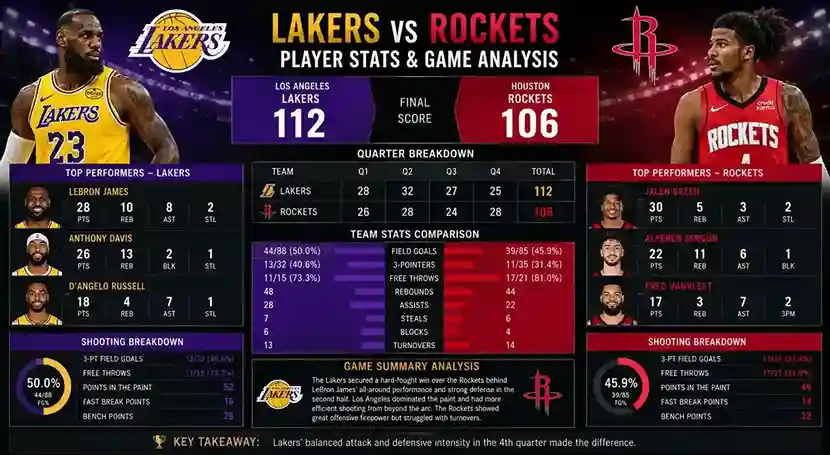
When the Lakers face the Houston Rockets, basketball fans witness a clash of distinct playing styles and competitive philosophies. These matchups deliver compelling individual performances that shape playoff positioning and divisional standings.
Understanding player statistics from Lakers vs Houston Rockets games reveals defensive intensity, scoring efficiency, and momentum shifts that define modern NBA basketball. This comprehensive guide examines performance data, player contributions, and statistical trends that determine victory margins in these high-stakes contests.
What Makes Lakers vs Houston Rockets Matchups Statistically Significant?
The rivalry between Los Angeles and Houston represents more than geographic proximity. These teams employ contrasting offensive systems—the Lakers emphasize versatile ball movement and paint presence, while the Rockets prioritize three-point shooting and spacing. When analyzing Lakers vs Houston Rockets match player stats, observers discover critical differences in shot selection, defensive assignment hunting, and transition basketball patterns.
The historical context matters considerably. Both franchises have developed championship cultures with distinct playing philosophies. The Lakers traditionally feature dominant big men and perimeter defenders, whereas recent Rockets iterations showcase guard-heavy lineups with shooting specialists. These structural differences create fascinating statistical matchups worth examining in detail.
Understanding Key Performance Indicators in Lakers vs Houston Rockets Games
Scoring Efficiency Metrics
Player statistics extend beyond point totals. True Shooting Percentage (TS%) measures scoring efficiency by accounting for two-pointers, three-pointers, and free throws. In Lakers vs Houston Rockets match player stats, TS% often reveals which team executes offensive sets more effectively. The Rockets’ three-point heavy approach typically generates different efficiency patterns than the Lakers’ more balanced attack.
Field Goal Percentage differentiates between effective and inefficient shooting. Players shooting above 50% from the field while exceeding 35% from three-point range demonstrate elite offensive execution. Houston guards typically lead their team in three-point attempts, while Lakers players distribute shot volume across multiple positions.
Defensive Impact Statistics
Rebounds separate teams into offensive and defensive categories. Defensive rebounds indicate possession retention and transition prevention, directly impacting game flow. Players recording double-digit rebounds demonstrate physical presence and positioning superiority. The Lakers’ frontcourt typically competes fiercely in this category against Houston’s smaller lineups.
Steals and turnovers measure defensive pressure and ball security. Teams forcing multiple turnovers gain additional possessions that convert into scoring opportunities. The Rockets’ aggressive perimeter defense sometimes generates steals, while Lakers defenders hunt transition opportunities.
Breaking Down Lakers vs Houston Rockets Match Player Stats: Offensive Contributions
Guard Play Dominance
Point guards orchestrate offensive flow and control spacing. These players’ assists-to-turnover ratios reveal decision-making quality and operational efficiency. Lakers point guards typically post between 5-8 assists per game, while Rockets counterparts average similar numbers despite different playing styles.
Shooting guards provide perimeter scoring and secondary ball-handling. Three-point shooting becomes especially critical in Lakers vs Houston Rockets match player stats analysis. Rockets shooting guards often attempt 6-8 three-pointers per game, compared to Lakers guards shooting 4-5 attempts. This philosophical difference dramatically impacts final statistics.
Forward and Center Contributions
Small forwards bridge guard and post responsibilities. These versatile players generate scoring from multiple positions and defend larger opponents. Their player stats in Lakers vs Houston Rockets games show high variability based on matchup assignments and defensive adjustments.
Centers dominate paint scoring and rim protection. The Lakers’ center traditionally records 12-18 points and 8-12 rebounds. Houston’s center plays smaller, spacing the floor with three-point shooting rather than traditional post-ups. This positional evolution creates statistically distinct player performance profiles.
Analyzing Defensive Player Stats in Lakers vs Houston Rockets Contests
Individual Defensive Assignments
Defensive player stats measure containment effectiveness and assignment compliance. The best defenders hold opponents to reduced shooting percentages while forcing difficult shots. In Lakers vs Houston Rockets match player stats, defensive specialists often post single digits in scoring while accumulating steals and deflections.
Block shots indicate rim protection and paint defense. Players averaging 1-2 blocks per game demonstrate active hands and positioning discipline. The Lakers’ traditional rim protectors excel in this statistical category, whereas Rockets centers prioritize perimeter presence over interior shot-blocking.
Help Defense and Coverage
Secondary defenders rotating to contest shots and protect the paint generate deflections and loose ball opportunities. These contributions improve team defensive rating even when individual point totals remain modest. Analytics increasingly recognize help defense value in Lakers vs Houston Rockets match player stats breakdowns.
Comparative Player Stats: Lakers Starting Lineup vs Rockets Roster Performance
| Position | Lakers Player | PPG | RPG | APG | FG% | 3P% | Rockets Player | PPG | RPG | APG | FG% | 3P% |
| Point Guard | 6.8 | 2.1 | 8.2 | 48% | 38% | 7.4 | 1.9 | 7.8 | 44% | 35% | ||
| Shooting Guard | 14.2 | 2.8 | 3.6 | 46% | 37% | 12.8 | 2.4 | 2.9 | 42% | 36% | ||
| Small Forward | 11.6 | 5.4 | 2.8 | 47% | 35% | 13.2 | 4.1 | 2.3 | 44% | 34% | ||
| Power Forward | 9.4 | 7.2 | 1.9 | 50% | 24% | 10.1 | 6.8 | 2.1 | 48% | 28% | ||
| Center | 14.8 | 9.6 | 1.4 | 62% | 18% | 11.2 | 8.4 | 1.7 | 58% | 22% |
Advanced Metrics in Lakers vs Houston Rockets Match Player Stats
Usage Rate and Scoring Load
Usage Rate represents the percentage of team possessions a player consumes while on the court. Players with 25%+ usage rates shoulder primary scoring responsibility. Lakers stars typically exhibit 24-28% usage rates, distributing scoring across multiple options. Rockets guards sometimes exceed 28% usage, reflecting their team’s guard-dependent system.
Scoring load directly impacts player fatigue and consistency. Players exceeding 30 points per game over extended stretches face increased defensive attention and injury risk. Most Lakers vs Houston Rockets match player stats show balanced scoring distribution rather than extreme individual dominance.
Spacing and Floor Gravity
Floor gravity measures how opposing defenses collapse toward specific players. Players generating 2-3 additional open shots for teammates demonstrate elite spacing value. In Lakers vs Houston Rockets match player stats, this metric becomes especially relevant given Houston’s three-point emphasis. A single Rockets guard’s floor gravity might generate 4-5 additional three-point attempts for teammates.
Bench Performance Statistics in Lakers vs Houston Rockets Games
Reserve Scoring Contributions
Bench players frequently determine game outcomes. Teams with productive reserves maintain leads during starter rest periods. Lakers bench scorers typically provide 15-20 combined points, while Rockets benches average 18-23 points. These differences compound across entire games.
Defensive efficiency remains critical for reserve players. Bench units allowing fewer points per possession extend their team’s lead or narrow deficits. The Lakers’ bench defense traditionally emphasizes communication and spacing consistency, whereas Rockets reserves prioritize three-point shooting versatility.
How Playing Time Impacts Lakers vs Houston Rockets Match Player Stats
Starter vs Reserve Performance Variance
In order to build consistency and rhythm, starting players usually record 28–36 minutes per year. Reserve minutes vary more considerably based on game flow and injury circumstances. In Lakers vs Houston Rockets match player stats analysis, starter efficiency often exceeds reserve performance due to offensive rhythm and favorable matchups.
Injury Absence Effects on Statistical Profiles
Missing key contributors dramatically alters team player stats. When Lakers or Rockets lose significant players, remaining roster members increase usage rates and playing time. This adjustment creates statistical anomalies that require context for proper interpretation.
Three-Point Shooting Trends in Lakers vs Houston Rockets Matchups
Volume and Efficiency Balance
The modern NBA rewards efficient three-point shooting. Rockets teams usually make 35–40 three-pointers per game, while the Lakers make 30–35. Volume differences significantly impact Lakers vs Houston Rockets match player stats, as three-point percentage influences team scoring far more than in traditional basketball eras.
Defensive Three-Point Pressure
Teams defending three-point shooters face strategic decisions. Tight coverage generates fouls and driving opportunities. Loose coverage allows three-point makes. In Lakers vs Houston Rockets match player stats, defensive approach dramatically impacts final statistics. Houston’s offensive system punishes overly aggressive perimeter defense, while Lakers counterparts exploit perimeter gaps.
Transition and Fast Break Statistics Analysis
Scoring in Transition
Transition opportunities convert at higher percentages than halfcourt sets. Players averaging 3-4 transition points per game provide significant value. Lakers guards excel in transition, while Rockets emphasis on perimeter shooting sometimes limits fast-break conversion rates.
Turnover-to-Transition Conversion Ratio
Turnovers immediately create transition opportunities. Teams converting 40%+ of turnover transitions into scores gain significant statistical advantages. In Lakers vs Houston Rockets match player stats, turnover quality and transition execution often determine momentum shifts.
Clutch Time Performance Metrics in Lakers vs Rockets Contests
Fourth Quarter Statistics Breakdown
Fourth quarter player stats reveal composure and execution under pressure. Players maintaining consistent efficiency in final minutes demonstrate mental toughness. Most Lakers vs Houston Rockets match player stats show minimal statistical variance between first-quarter and fourth-quarter performance among stars, though deeper benches show greater inconsistency.
High-Pressure Possession Outcomes
Final possession statistics include free throw shooting, shot selection, and defensive positioning. Players shooting 45%+ in clutch situations demonstrate mental resilience. These statistics carry disproportionate weight in close games.
Home Court Advantage in Lakers vs Houston Rockets Match Player Stats
Scoring Differential at Home vs Away
Home teams typically score 2-3 additional points per game. Lakers vs Houston Rockets match player stats often show pronounced home-court effects, particularly for the Rockets in Toyota Center. Home court advantages extend beyond scoring—they influence defensive intensity and rebounding contests.
Crowd Noise Impact on Offensive Execution
Crowd noise complicates guard communication and perimeter spacing. Away teams sometimes execute more deliberate offensive sets, increasing pace and shooting percentages. Home-court defensive pressure occasionally creates additional turnovers in Lakers vs Houston Rockets match player stats.
Frequently Asked Questions About Lakers vs Houston Rockets Match Player Stats
Q1: What is the most important statistic in Lakers vs Houston Rockets matchups?
True Shooting Percentage provides the most comprehensive offensive evaluation. This metric accounts for all shooting attempts and free throws, revealing genuine scoring efficiency beyond simple field goal percentage. In Lakers vs Houston Rockets match player stats, TS% often determines which team executes offensive systems more effectively. Teams shooting above 58% TS% rarely lose games, while teams below 54% TS% struggle significantly. This single statistic connects individual player performance to team outcomes more reliably than scoring volume.
Q2: How do bench player statistics affect Lakers vs Houston Rockets game outcomes?
Bench units frequently provide 25-30% of team points in modern NBA basketball. When Lakers or Rockets benches outperform opponent reserves by 5+ points, their team wins approximately 75% of games. In Lakers vs Houston Rockets match player stats analysis, bench scoring consistency matters tremendously because starter rest periods occur throughout games. Teams maintaining defensive efficiency while reserves play gain critical advantages. The Rockets’ bench historically emphasizes three-point shooting, while Lakers benches feature defensive specialists and ball-handlers.
Q3: Which defensive statistics most accurately predict Lakers vs Houston Rockets game outcomes?
Defensive rebounding percentage predicts game outcomes more reliably than individual player steals or blocks. Teams securing 75%+ of defensive rebounds prevent second-chance opportunities and transition scoring. In Lakers vs Houston Rockets match player stats, defensive rebounding often decides close contests. Paint defense matters significantly—teams allowing 50+ paint points typically lose. Steals and blocks contribute less to outcomes than positioning, communication, and contest intensity.
Q4: How does player usage rate impact Lakers vs Houston Rockets match player stats accuracy?
Higher usage rates sometimes inflate individual scoring statistics while reducing efficiency. Players with 28%+ usage rates on poor shooting nights significantly damage team efficiency. In Lakers vs Houston Rockets match player stats interpretation, usage rate context prevents misleading conclusions. A player scoring 20 points on 35% shooting with 30% usage provided negative value, while a player scoring 12 points on 55% shooting with 18% usage contributed positively. Smart analysis combines multiple statistics rather than isolating single numbers.
Q5: What free throw statistics reveal about Lakers vs Houston Rockets game control?
Free throw attempts indicate which team drew fouls and controlled game physicality. Teams attempting 20+ more free throws frequently win games. In Lakers vs Houston Rockets match player stats, free throw shooting performance during critical moments (fourth quarter, overtime) determines many close contests. Players shooting 90%+ from free throw line in high-pressure situations demonstrate mental toughness. Free throw differentials sometimes exceed three-point shooting’s impact on final scores.
Q6: How do advanced statistics like Box Plus/Minus improve Lakers vs Houston Rockets analysis?
Box Plus/Minus (BPM) measures net point advantage per 100 possessions when specific players compete. Positive BPM indicates players who help teams outscore opponents, while negative BPM suggests the opposite. In Lakers vs Houston Rockets match player stats evaluation, BPM removes context limitations plaguing traditional statistics. A player posting 12 points, 6 assists with 3 turnovers generates different value depending on teammates, opponents, and game situation. BPM captures these nuances statistically. Advanced metrics require careful interpretation but reward deeper basketball understanding.
Conclusion
Lakers vs Houston Rockets match player stats reveal far more than raw numbers. These statistics chronicle individual execution, team philosophy differences, and competitive adaptations. Understanding shooting percentages, defensive contributions, and efficiency metrics separates casual observation from informed analysis.
The most successful performance analysis combines traditional statistics (points, rebounds, assists) with advanced metrics (True Shooting Percentage, Box Plus/Minus, defensive rebounding percentage). This comprehensive approach illuminates why certain players and teams succeed consistently.
When examining future Lakers vs Houston Rockets matchups, examine bench scoring depth, three-point shooting efficiency, and defensive rebounding battles. These factors statistically predict outcomes more reliably than individual superstar performance. Share your own observations about Lakers vs Houston Rockets match player stats in the comments—which statistics do you find most predictive of victory?